 Skip to content
It’s hard to say for sure because of the wizardry involved. But Egyptian forward Haissem Hassan took what looked like eight touches of the ball on every part of his left foot imaginable, dancing in between and around two Argentine defenders, before ever putting it on his right. One touch on that right foot, followed by a final move from his left, and the Egyptian forward had done most of the legwork for what will go down as one of the most memorable moments of the 2026 World Cup.
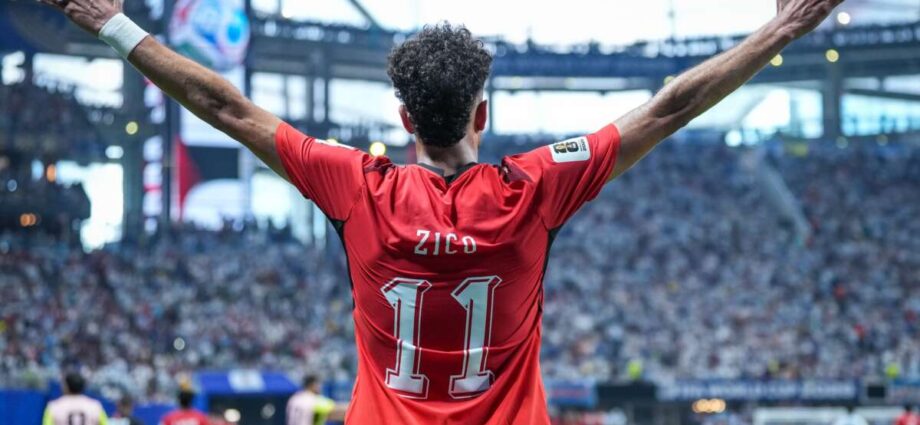
The crowd where I was, outside a jam-packed cafe in New York’s Little Egypt, was by this point in the midst of a crescendo that peaked a few seconds later: three dribbles and a pass from Egyptian icon Mohamed Salah, followed by a glorious goal by Mostafa Zico.
Utter joy broke out in the cafe. Egypt was beating Lionel Messi’s Argentina 2-0, and everyone at the cafe knew we would remember where we were when we saw Zico’s shot hit the back of the net.
And we still will — but not for the reasons we thought. A video review ruled out the goal because of a foul committed in its buildup. And though Zico did later score a goal that wasn’t disallowed, Argentina quickly scored three and won the match.
In the space of about half an hour, the cafe went from feeling like a party to a funeral. A dramatic loss in the dying minutes of a game would be devastating for any fan base. But when it happens in the context of dubious refereeing decisions, in a tournament run by a famously corrupt organization, the despair can take on an extra edge.
Allegations of Rigging
The words “rigged” and “corruption” filled Little Egypt’s Steinway Street after the match and were all over social media feeds as well. “It needs to be a fair game, and today I don’t think it was a fair game. It’s really a shame on FIFA … something doesn’t feel right,” said Mohamed Bakar, who drove from Pennsylvania to New York just to watch the game among Egypt’s fans on Steinway.
Members of the Egyptian team did not hold back either.
“The referee was not fair. The injustice was clear. There’s been an unfairness right from the start of the match. A 2-0 lead is not enough to beat Argentina. It’s clear that the tournament has been fixed,” said an emotional Zico in a post-match interview.
Coach Hossam Hassan felt similarly. “The result was influenced by internal factors on the pitch and external factors off it,” he said. “Perhaps they wanted to keep the world champion in the competition. Perhaps they wanted Messi to stay in the running.”
To be clear, there is no evidence that definitively supports those claims. But the people making the allegations point to a pattern of decisions that seem to have favored the defending champions, and in the case of this match, come at Egypt’s expense. The focal point of the controversy was the foul committed ahead of Zico’s goal that happened about 20 seconds earlier, and roughly 100 yards away — factors that usually mean they are no longer relevant. And many point out that when similar incidents seemed to occur before Argentina’s goals — both during the Egypt match, and earlier in the tournament — the same decision was not made.
FIFA has repeatedly gotten into bed with authoritarian leaders while prioritizing commercial aspirations over human rights.
As Stefan Szymanski, my co-host on “The Soccernomics Podcast” said in our most recent episode, there is a bias that exists because of the fact that Messi is the best player in the world, and perhaps in the history of the sport. “It will always be the case that the best players will get asymmetric treatment,” Szymanski said. “They’re going to get better treated than the rest because they’re the moneymakers…. Even just the selection of the referee is something that a player like Messi can influence, and this is kind of well-known as a fact.”
The bias Szymanski is talking about isn’t necessarily conscious. One cannot just look at these incidents and definitively conclude the World Cup is rigged, and yet so many people do. What’s interesting is to consider why.
FIFA’s Shady Past Makes People Believe the Worst
In a series for Zeteo called “The Dark Side of the World Cup,” my colleagues and I detail FIFA’s history of corruption, criminality, and corporate greed. The organization has repeatedly gotten into bed with authoritarian leaders while prioritizing commercial aspirations over human rights. The most high-profile example was the U.S. Department of Justice–led investigation about a decade ago that resulted in nine FIFA executives being indicted for racketeering, wire fraud, and money laundering conspiracies — and the eventual resignation of former FIFA President Sepp Blatter. Fans of the sport know this, and are constantly in a struggle with the Zurich-based behemoth over who really owns the game.
The result? A breeding ground for conspiracy based on the belief, held widely among fans of the sport, that FIFA is willing to do anything in the name of money.
In the lead-up to the World Cup, current FIFA President Gianni Infantino cozied up to Donald Trump while the U.S. president bombed seven countries after retaking office and allowed his secret police force to round up immigrants and kill U.S. citizens at home. Though all of this flies in the face of FIFA’s human rights policy, Infantino seemed happy to selectively ignore it all to ensure the smooth operation of a tournament that’s expected to generate almost $9 billion for the organization.
In the opening weeks of the tournament, the biggest controversy was the treatment of the Iranian team, which was forced by U.S. visa restrictions to travel back and forth between Mexico and the U.S. between its games. This travel killed the Iranian players’ preparation and recovery time, and when a goal that would have sent them to the next round of the World Cup was ruled out — the same day that the World Cup’s host country was bombing their own — many Iranians felt the decision was another injustice.
As this tournament reaches its apex, controversies that feed into that idea that the World Cup is not fair seem to be everywhere you look.
But as this tournament reaches its apex, controversies that feed into that idea that the World Cup is not fair seem to be everywhere you look. The fallout from Egypt’s exit from the tournament wrestled the headlines from another story that hadn’t exactly improved the optics: Trump’s meddling in the suspension of U.S. star Flo Balogun for the host nation’s match with Belgium.
Balogun wasn’t supposed to play in the match, after picking up a red card against Bosnia-Herzegovina. But after Trump put in a call to Infantino, suddenly he was able to play.
Like some of the theories doing the rounds about Egypt’s loss, we can’t say definitively that Trump’s call was the decisive factor in the decision. And Infantino insists it was made independently and autonomously by the FIFA Disciplinary Committee. But in the context of FIFA’s dodgy past, people find it easy to believe the worst.
The rhetoric from the U.S. hasn’t helped with the optics.
While Trump openly advertised that he requested that FIFA review the decision, Andrew Giuliani — the head of the White House Task Force on the FIFA World Cup 2026 — somehow thought invoking Trump’s record on electoral integrity was the right way to defend him, saying: “We believe in a level playing field … I can tell you President Trump takes it extremely seriously, whether it’s on the pitch or whether it’s in the ballot box.”
Feelings of Injustice From the Global South
I am among the people angered about what happened in the Egypt match, and many others who also have ties to the Global South have felt the same way. And just as is true for all sports fans who pay attention to broader geopolitics, the emotions we feel about sports are often about something bigger than whatever’s happening on the field of play.
And whether it’s Egypt, Iran, or Ghana in its match against England, there is a deep sense for many who support these teams that it’s smaller, poorer, less powerful countries that are disproportionately on the receiving end of injustice in sport — up to and including refereeing decisions.
People from these parts of the world are already on the receiving end of so many of the world’s inequalities. Whether it’s Western militarism — from the ongoing genocide in Gaza to the U.S.’s illegal war in Iran — or the effects of colonialism, which continue to shape inequity and political stability around the globe, people feel these injustices in their bodies every day.
Sports are supposed to be an escape from all of that — a place in which countries that have been on the receiving end of imperial brutality have a rare chance to compete with each other and with world powers on a level playing field, and dream they can actually pull off what is often deemed to be impossible. And when they do so well and get so close, to have it then taken away because of a questionable refereeing decision on the field is a gut punch. And when even sport proves to be unfair, what do we have left?
Sports are supposed to be a place in which countries that have been on the receiving end of imperial brutality have a rare chance to compete with each other and with world powers on a level playing field.
Last month, Stefan Szymanski and I co-wrote a piece in The Economist that this may just be the last World Cup, arguing that football’s world order could break down as a result of FIFA enabling American bellicosity.
But could widespread feelings that the tournament is rigged be the breakage point instead? If many in the Global South now refuse to watch what remains of the World Cup because they no longer see it as a fair competition, where does that leave the tournament? And will those fans return for 2030?
Chances are that for many, the answer is yes. Because what history has shown us is that no matter what they’re served by FIFA and the authoritarian nations that host World Cups, most people keep coming back. We love the game too much. Perhaps our mistake was to ever believe the illusion that sport could be an escape from the cruel world it inhabits.
Putting the World at the Heart of the World Cup
When North African teams win World Cup matches, Astoria’s Steinway Street is a party. But in the hour after Tuesday’s match, most people were in a state of shock. Slowly but surely though, they began to gather — chanting, singing, letting off fireworks. They were still proud of their team.
While Bakar stood in the middle of the street waving an Egyptian flag, many around him waved Palestinian flags as well.
In Gaza, watch parties for Egypt games during this World Cup became a source of joy for Palestinians who have endured a genocide over the past two and a half years. Egyptian Coach Hassan’s use of his platform at the World Cup to speak out about their plight only increased the connection to the team.
“If there is anyone in the world who does not feel for the Palestinian people, then they are not human — whether they are Arab, European, or American,” he said ahead of the match with Argentina.
For many in Gaza, Hassan’s words and actions were particularly powerful because of where they were happening.
“When Hossam Hassan raised the [Palestinian] flag in the very land that funded the genocide and was a strong ally for the genociders and the children killers — this moment stands like a reminder that Palestine [is] in the heart, Palestine will not be forgotten, that Palestine is always seen,” says Hend Salama Abo Helow, a writer based in Gaza whose work has appeared in Truthout and other outlets. “It was so uplifting. Such a satisfying moment to see Palestine resurface again, and Gaza resurface again [on the world stage].”
The controversy over the refereeing seems to have struck a chord with Palestinians, many of whom even believe the refereeing decisions were a form of retribution for the Egyptian team’s pro-Palestine advocacy.
The joy Palestinians have derived from the Egyptian team has even been marred by Israeli violence: Before the match, Mohamed al-Wahidi, an aid worker who had been key in organizing those watch parties in Gaza, was killed in an Israeli airstrike — another reminder that even as the World Cup brings people together in many ways, violent powers continue to prevail.
And in that context, the controversy over the refereeing seems to have struck a chord with Palestinians, many of whom even believe the refereeing decisions were a form of retribution for the Egyptian team’s pro-Palestine advocacy.
“Every Gazan felt the injustice imposed on the Egyptian team. They were punished for being brave enough to stand on the right side of history,” Abo Helow told me. “Regardless of the final score, Egypt’s team won something far greater in the eyes of Palestinians: the test of humanity.”
That solidarity was returned by Egyptian fans in New York, for whom the best antidote to a post-match malaise seemed to be singing and dancing to the popular song, “Ana Dammi Falasteeni” (My Blood Is Palestinian).
Somehow, in the wake of a devastating loss, they still found a way to come together. I will always remember that moment, as well as the celebrations after Zico’s disallowed goal.
It was a beautiful moment. It was an iconic goal. And whether it shows up on the scoresheet or not, nobody can ever take away the fact that those of us in New York’s Little Egypt all experienced it together.
An important fundraising appeal: 10 Days to raise $50,000
Truthout is one of only a few platforms for justice-oriented, grassroots journalism. Today, as political censorship from the right intensifies, we have no choice but to ask for your help.
We are fundraising right now to cover our basic operating expenses. If you can support Truthout with a one-time or monthly donation, you will make a significant impact on our work. Anything you can do makes a difference — we appreciate your support.
