 Skip to content
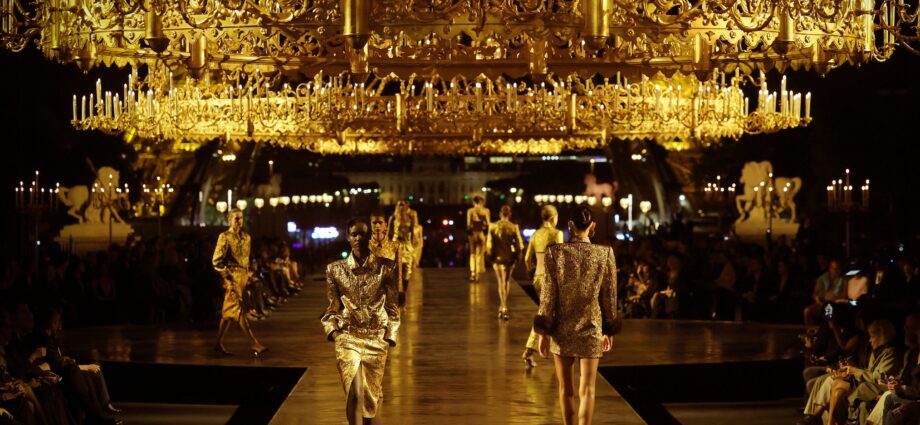
Following weeks of speculation, on Friday morning Anthony Vaccarello said that he would be leaving Saint Laurent after 10 years as its creative director. The announcement followed a blockbuster show during Paris Fashion Week that saw Vaccarello reinterpret the work of Yves Saint Laurent with his own signature panache. In 1991, Saint Laurent closed his fall-winter 1991 Rive Gauche runway show with a finale parade rendered almost entirely in gold fabrics. This season, Vaccarello showed a collection of gilded ready-to-wear that concluded with a procession of blacked out evening wear. It looked like the most glamorous of funeral marches, a poignant ending to his prolific tenure.
His run at Saint Laurent was unusual amidst a period of upheaval across the industry. Last year, the spring-summer 2026 collections in September and October saw a great reset in fashion: designers across over a dozen luxury brands including Dior, Chanel, Gucci, and Balenciaga welcomed new creative directors, sometimes swapping them from one to the other. Vaccarello hitting the ten-year mark made him an outlier, and he had settled in nicely at Saint Laurent and found his way around reinterpreting its legacy. Unlike the wobbliness of some of his colleagues’ efforts, he was standing on firm ground having had the luxury of time when it comes to carving out a vision.
In the decade in which Vaccarello designed Saint Laurent he grew from underdog to alpha. When he was hired in 2016, Vaccarello was a well-liked designer in his late 30s, known for his razor-sharp cutting and very sexy output at Versus, the Versace diffusion line, and at his eponymous brand, which he closed upon arriving at Saint Laurent. Over time, his exacting, uncompromising vision made Vaccarello one of this era’s most compelling fashion designers: his collections became singularly focused on a seasonal silhouette and idea, and his vision—sensual, polished, and stubbornly svelte—evolved from contentious to almost refreshing, had it not been so limiting. While much of the fashion world became fixated on fleeting trends and virality, Vaccarello’s discipline remained unchallenged. “When people say, ‘Oh, it’s repetitive,’ I love that,” he told Vanity Fair earlier this year, laughing. “I like that when you leave the show, you have in mind the silhouette of the season,” he said. “I like to go to the essential.”

The blackout finale parade at Vaccarello’s show in Paris.
Victor VIRGILE/Getty Images
In the last five years of his tenure, Vaccarello’s collections were laser focused on the work of Saint Laurent himself, referencing sometimes his greatest hits (Le Smocking, or the women’s tuxedo or the Saharienne, his iconic safari jacket), his lesser celebrated eras (like the ’90s, when Vaccarello said Saint Laurent was “not cool”), and even his personal uniform. These collections put into focus how a designer could celebrate a house’s legacy by embracing the tension between the look of decades-old fashion with contemporary style rather than rejecting it. Vaccarello did not always hit the bull’s eye, and the narrowness of the collections meant that while he was bringing the legacy of Saint Laurent to the forefront he was not always expanding it. Still, he did find a way of making the history of Yves Saint Laurent relevant to a generation that had fallen detached from it.
It’s a balance that many of his colleagues managing legacy brands today have not been able to strike just yet. It took Vaccarello some five years to get his bearings at Saint Laurent. Judging by how things went at Paris Fashion Week this season, only some designers will get there in the same time frame, if at all.

Mugler, spring-summer 2027 by Miguel Castro Freitas
Victor VIRGILE/Getty Images

Mugler, spring 1997 haute couture
Daniel SIMON/Getty Images
Miguel Castro Freitas, the new designer at Mugler, showed his first collection a year ago in Paris, an effort that promised a re-alignment with Manfred Thierry Mugler’s point of view on tailoring and ready-to-wear. This season’s collection mined the naturalistic pocket of Mugler’s imagination: his animalistic designs and his era-defining Les Insectes haute couture show from spring 1997. The involved craftsmanship throughout the collection was impressive, and it certainly evoked the world of couture, but models seemed to struggle to get through the full runway, and the looks in the show that appeared to be made for the retail floor were not particularly compelling.
Castro Freitas may find his footing, and the fact that Mugler has a robust fragrance business to rely on, will likely buy him some time. What he should avoid, however, are gimmicks that take the focus away from this endeavor.
Front row at his show was Alexis Stone, the drag artist who happens to be one of fashion’s most viral guests, having attended runway shows by Demna at Balenciaga and Glenn Martens at Diesel impersonating a variety of real and invented characters, like Mrs. Doubtfire and Jennifer Coolidge.

Alexis Stone as Manfred Thierry Mugler
Victor Boyko/Getty Images

Stone arriving at the Mugler show in Paris
Claudio Lavenia/Getty Images
Stone turned up at the Mugler show last weekend dressed like the late Manfred Thierry Mugler, working with the house on the stunt and with the blessing of Mugler’s partner. Stone wore a look drawn from Mugler’s personal wardrobe, including one of his brooches. Per usual, it was impeccably achieved.
And yet the appearance landed as somewhat misguided. Mugler is a house built partially on provocation, but Mugler, the man, died only a few years ago. Stone arriving with a black veil draped over his head to execute a “reveal” in front of a group of photographers cheapened the feat, and, despite the performance being billed as a homage, it rather felt like an attempt from the brand to hold on to the Mugler legacy by physically inviting him into the space and by too-closely referencing some of his greatest hits. There has to be a better way for Mugler, the house, to preserve its ties with Mugler, the man.
At Dior, Jonathan Anderson is underway with his own ambitious renovation of one of fashion’s most recognizable names. This season, he rendered his collection light and flouncy, but he did not do away with the excess that has thus far defined his vision for Dior: the layers, the jewelry, the footwear, and the bags. Each look is finished with one or two or three or four elements, which makes for a rich picture and a visual feast, but it can be superfluous. The collection was at its most clear when Anderson let a piece or two do the talking: a beautiful coresetted dress that appeared so weightless that it looked unimaginably comfortable, a sheer, little jacket with a short skirt, or some shiny jeans and a frilly blouse. It appears that where Anderson leans on instinct rather than the weight of the Dior language—with its feminine frills,tons of florals, or the Bar jacket silhouette—he has a firmer grasp on what his version of Dior could and should be.
.jpeg)
Dior by Jonathan Anderson
Adrien Dirand

Balmain by Antonin Tron
Justin Shin/Getty Images
Antonin Tron and Drew Henry, the new designers at Balmain and Courrèges, respectively, have the unique challenge of reinvigorating two brands whose founders were instrumental to fashion but whose legacies are less widely understood today. Tron has decided, it seems, to embrace the ostentatiousness of Balmain, aligning it to the bourgeois and holding on to the gilded fantasy that his predecessor, Olivier Rousteing, had put at the core of the brand. Though within his collection this season, rendered sexy and ready for a night out, it was not entirely clear where Pierre Balmain himself came in. André Courrèges is remembered within fashion for his ’60s modernism and space age aesthetic, and Henry closely referenced some of his silhouettes, particularly a mini shift dress he put on male models, but advanced them in texture and color.
Matthieu Blazy has made his collections at Chanel unfold like a biography of founder Gabrielle “Coco” Chanel. He’s stepped away from the biggest trope about her life, her revolutionary reconfiguration of a woman’s wardrobe in the 1920s, which established Chanel as a sartorial oracle, and decided to dig deeper into her life to unearth what has become a cabinet of delightful curiosities.

The opening look of Blazy’s latest Chanel show
Chanel

The closing look
Chanel

Gabrielle’s personal Chanel bag
Virgil CLAISSE/Getty Images
Blazy said he looked to different parts of Chanel’s life this season—her youth in the Edwardian era, her early fascination with men’s clothes, her admiration for Edgar Degas—as he designed this collection. It made for a stimulating show that allowed Blazy to challenge the collective conception of what Chanel is as a brand—a prim tweed skirt suit—without straying too far from its core tenets. The show opened with a model in a sheer set with lingerie details, an unseemingly sexy look for Chanel, carrying Gabrielle’s own Chanel flap bag, which is preserved in the Chanel Patrimoine, the archival and heritage department of the house. The closing look circled back to the same idea, but this time the same model carried the bag with a black skirt suit, the most undiluted iteration of Chanel. It was as if Blazy was telling us that, after all his audacious innovations, all roads will always lead back to the classics.
“I always think that it’s hard to do a good job several times,” Vaccarello said earlier this year when discussing how many of his colleagues had left their positions at brands to tackle bigger challenges. It’s not surprising that, when asked who he thought was getting it right the second time around, he mentioned only Blazy.
-
Erika Kirk Doesn’t Really Want to Talk Politics. So How’s She Going to Lead Turning Point USA?
-
A Deep Dive Into How Larry Ellison Built His Influence
-
Making the Elizabeth Holmes Doc Fried Nathan Fielder’s and Lance Oppenheim’s Brains
-
Inside Wallis Simpson’s Quest for the World’s Most Beautiful Jewelry
-
Inside Lane Kiffin’s Trash-Talking, “Joey Freshwater” Era With Nick Saban at Alabama
-
From the Archive: Inside Elizabeth Holmes’s Chilling Final Months at Theranos
