 Skip to content
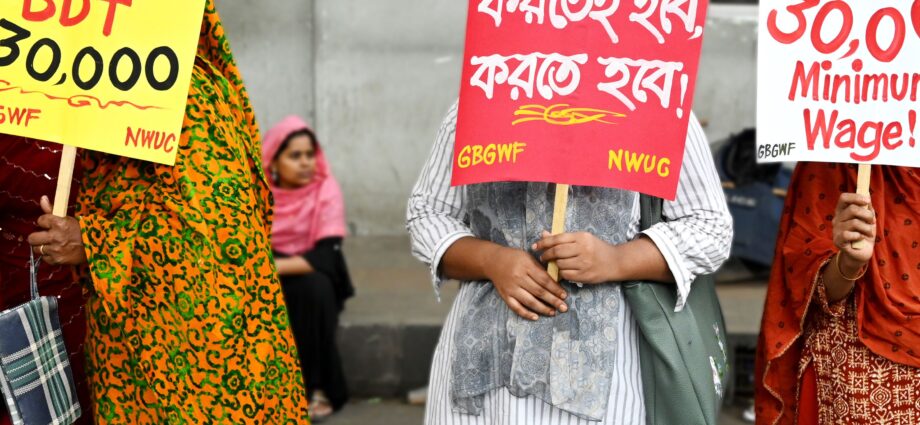
The Mirpur area of Bangladesh’s capital, Dhaka, is usually a hive of activity. One of the country’s five major manufacturing hubs, it is home to more than 300 garment factories, making clothes for global brands and retailers including Walmart, H&M, Zara, Levi’s, Marks & Spencer and Primark. But on Thursday, the last working day of the week in Bangladesh, the area was eerily quiet.
The calm comes after a stormy week, which saw workers take to the streets to protest the national minimum wage, demanding the formation of a government-led Minimum Wage Board and a substantial raise from BDT 12,500 (around $100) to BDT 30,000 (around $240) per month. On November 2, more than 600 of the country’s 4,000 garment factories were forced to suspend operations for the day due to protests. By Tuesday, one worker had been killed in Gazipur, another major industrial hub, as law enforcement agencies moved to contain the unrest, which had spread across major garment manufacturing centers, disrupting factory operations and traffic. Police say more than 100 people were arrested. And by Wednesday, there was a slight reprieve: protests temporarily subsided as the government announced a Minimum Wage Board, and declared that a revised minimum wage structure for garment workers will take effect in December, with higher payments reflected in January payslips.
While the Minimum Wage Board is unlikely to meet protestors’ BDT 30,000 demands ($240), its formation is seen as a major step forward. Wage structure for garment workers hasn’t changed since 2023. “We can say our first demand has been met, as a wage board has been formed and they said that the new wage will take effect in December,” says Sajal Sardar, a sewing machine operator at a knitwear factory in Mirpur. Sardar is one of around four million garment workers in Bangladesh, more than half of whom are women. Despite serving as a cornerstone of the national economy, these workers continue to live in difficult conditions.

Minimum wage protests in Bangladesh – and the response from police – have caused significant disruption in key garment making districts.
Photo: Shamim Us Salehin via Getty Images
A decade ago, 23-year-old Sardar started working in factories as a child. During that time, he has been unable to build up any savings, as the minimum wage is so scant. He belongs to a family of seven, in which he and his brother are the only earners, bringing home a combined monthly income of around BDT 30,000. He personally earns BDT 14,200 ($115) of that — or BDT 17,000-18,000 ($136-144) with overtime. At times, the family is forced to borrow money to meet unexpected expenses, such as medical costs and younger siblings’ tuition fees.
Like many of the workers involved, Sardar sees protesting as a last resort, prompted by years of unmet government promises and rising living costs. “We don’t want to take to the streets,” he says, “but there is no affordable healthcare for us. Landlords keep raising house rents every January. The prices of staple food items and cooking gas have gone up several times during this period, and our wages have remained the same.”
The latest round of protests follow intense clashes throughout 2023, after which the former Bangladeshi dictator Sheikh Hasina was ousted in a student-led popular uprising. An interim government led by Nobel laureate Muhammad Yunus took office in 2024, and was replaced by the current government following elections in February 2026. When Yunus was installed, the new government introduced a legal requirement to form a wage board that would review minimum wages every three years, replacing the previous five-year interval. But progress has been slower than expected. “The government should have initiated the process by forming the wage board six months before the ending of the three-year tenure,” says Sardar.
Unions support the decision to determine a new minimum wage in December, says Khairul Mamun Mintu, a union leader at the Bangladesh Garment Workers Trade Union Center. But if the proposed restructure fails to meet protestors’ demands, the fight will continue. “We have placed our demands. Now, stakeholders will decide what would be a reasonable wage for all. “If that also doesn’t work, we will have to take to the streets again.”
Can Bangladesh afford to meet protestors’ demands?
It’s been a difficult few years for Bangladesh’s economy, casting considerable doubt over whether the proposed minimum monthly wage of BDT 30,000 ($240) is achievable. Although the country’s export earnings rose 6% to $17.04 billion in the third quarter, the trade deficit widened by 31% year-on-year to $7.48 billion, as the war in the Middle East sent its fuel import bill soaring. The new Minimum Wage Board will need to balance these considerations with workers’ demands.
Projections by independent institutions also point to mounting economic challenges. The Asian Development Bank (ADB) has lowered its growth forecast for Bangladesh for the current year to 4%, while projecting inflation at 9% (experts warn that the actual rate could be as high as 20%). Meanwhile, the World Bank has also sharply downgraded Bangladesh’s growth forecast for the 2026-27 full year to 3.4%, down from 4.6% in June and 6.1% in January.

This downward spiral has hit fashion manufacturing hard. The new government, led by Tarique Rahman of the Bangladesh Nationalist Party (BNP), which assumed office following the February 12 election, has raised fuel prices twice, in April and September, resulting in a cumulative increase of more than 35%. And electricity prices at the retail level also rose by more than 16% in June. Meanwhile, retail Liquefied Petroleum Gas (LPG) prices have increased in two consecutive hikes over the past two months, climbing from BDT 1,625 ($13) to BDT 2,060 ($16) per 12 kilogram cylinder. In March, the same cylinder cost BDT 1,340 ($10).
All of this means fashion manufacturers are grappling with a tight squeeze on prices, even before potential wage increases come into play. If brands aren’t willing to pay more to accommodate these cost hikes, it’s likely that workers will bear the brunt.
How should fashion brands respond?
The latest wave of protests has caused substantial losses for factory owners, who manufacture clothes for global fashion brands at relatively low prices. ABM Shamsuddin, a factory owner who represents manufacturers on the newly formed six-member wage board, said the unrest has caused shipment losses worth BDT 850 million (around $68.3 million).
International buyers tend to pursue three options in these circumstances, he says. Ideally, they would accept delayed shipments without imposing penalties, but more likely they will demand that products be delivered at a 50% discount, or ask factories to send the shipments by air rather than sea shipping. Either choice would be a significant financial hit for the factory owner. Instead, he hopes global brands acknowledge that the unrest was beyond factory owners’ control. “They can see what is happening here.”
The Clean Clothes Campaign (CCC), a global network of labor unions and non-governmental organizations, is urging global fashion brands sourcing from Bangladesh to support garment workers’ demands. Ideally, brands would also publicly commit to continue sourcing from Bangladesh and ring-fence labor costs, or offer commercial terms that would enable suppliers to pay the new minimum wage, reassuring the government and employers that higher wages would not drive production to other countries. “It is crucial that brands act immediately and speak out in support of workers’ demands rather than waiting until the wage negotiations are over,” the organization’s living wage coordinator Anne Bienias said in a statement.
According to Mahmud Hasan Khan, president of the Bangladesh Garment Manufacturers and Exporters Association (BGMEA), the apex body representing garment manufacturers, protests tend to erupt whenever the time comes to revise workers’ wages. Such persistent unrest has undermined international buyers’ confidence in Bangladeshi manufacturers, but angst is misdirected toward protestors and factories. “They (the buyers) can convey their concerns to the government in writing,” says Khan. “Both their interests and ours are at stake.”
The bigger issue is the lack of collective bargaining mechanisms inside factories, adds Kalpona Akter, president of the Bangladesh Garment and Industrial Workers Federation (BGIWF). “If workers could negotiate directly with factory owners inside the factories, they wouldn’t have to take to the streets,” she says. Often, by the time the government has reviewed wages and made incremental changes, progress is obsolete, she adds, pointing to the interim government’s previous attempt to raise the annual wage increment for garment workers from 5% to 9%. “Since the basic salary is quite low, the increment does not make much difference. Commodity prices rise at a pace that wages cannot keep up with.”
Union leaders say that while manufacturers and the government are responsible for ensuring workers’ welfare, international buyers also have a share of the responsibility. A report published in May by the CCC and Public Eye found that global fashion brands were paying almost the same prices per item as they did 20 years ago, with some prices even 30% lower in inflation-adjusted terms. This, the report said, “undermines suppliers’ economic resilience and depresses wages”, adding that buyers still source a standard cotton T-shirt for around $2-3 per piece, with some paying as little as $1.
This race to the bottom is compounded by the country’s low labor costs, says Akter: “[Brands] enjoy the bigger piece of the pie here.”
Moving forward, Akter says manufacturers should first increase workers’ wages and then negotiate with buyers to ensure that the additional costs are reflected in purchasing prices. “Otherwise, buyers will stand firm on their position, manufacturers will keep bleeding, and workers will keep protesting on the streets.”
