 Skip to content
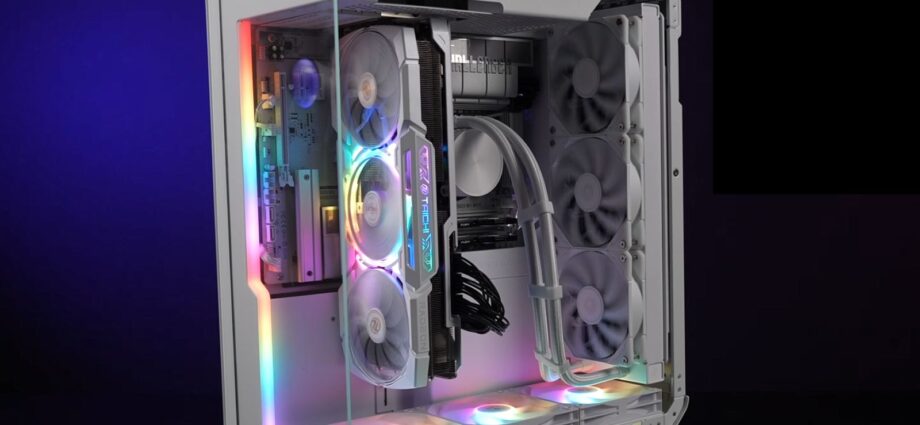

Linux-based gaming platforms such as SteamOS continue to gain attention as alternatives to Windows. To explore how they compare in real-world use, YouTuber ETA Prime tested an all-AMD desktop PC running both Windows 11 Pro and SteamOS, examining gaming performance across several titles.

The specs of the all-AMD gaming PC as detailed by the YouTuber include an AMD Ryzen 7 9800X3D processor with eight cores and 16 threads, paired with 32 GB of DDR5 memory running at up to 7,000 MT/s in dual-channel configuration. The processor is currently listed at $469 on Amazon. The system is built on an ASRock B850 Challenger motherboard and uses an AMD Radeon RX 7900 XTX graphics card with 24 GB of VRAM. The GPU is currently listed at around $889 on Amazon. Storage is split across two separate 1 TB NVMe SSDs, one running Windows 11 Pro and the other running the official release of SteamOS. Power is supplied by an 850 W Gold-rated power supply.
ETA Prime notes that the component selection was made with SteamOS compatibility in mind, with all hardware working out of the box on Valve’s official operating system. The SteamOS installation used for testing was version 3.7.17 on the stable channel, without opting into beta branches. Features such as variable refresh rate (VRR), scaling options, and system-level tuning were enabled where supported, with CPU and GPU tuning handled directly through the BIOS rather than third-party tools.
Windows 11 vs SteamOS: 4K gaming performance comparison across AAA titles
To provide a direct comparison, ETA Prime ran several titles on both operating systems using identical settings. In Cyberpunk 2077 at 4K Ultra with no FSR, Windows 11 averaged 84 FPS, while SteamOS recorded 85 FPS, effectively placing both platforms on par.
Borderlands 4 showed a small advantage for Windows 11, with an average of 74 FPS compared to SteamOS’ 69 FPS at 4K Ultra with FSR Quality enabled. Forza Horizon 5 displayed one of the larger gaps, with SteamOS averaging 157 FPS at 4K Extreme settings without FSR, while Windows 11 reached 191 FPS. ETA Prime suggested that the difference may be influenced by the title’s close ties to Microsoft’s ecosystem.
In contrast, Marvel’s Spider-Man 2 slightly favored SteamOS when tested at 4K Very High with FSR set to Quality, averaging 111 FPS compared to 103 FPS under Windows 11. Red Dead Redemption 2 at 4K Ultra without FSR averaged 88 FPS on SteamOS and 96 FPS on Windows 11.
The YouTuber also individually tested other popular titles such as Left 4 Dead 2, The Witcher 3: Wild Hunt, and Doom: The Dark Ages at 4K on SteamOS, with the full tests shown in the video linked below.
Overall, the results indicate that performance varies depending on the game, with neither operating system holding a consistent advantage across all titles. ETA Prime concludes that the dual-boot approach offers flexibility, allowing users to choose the operating system that performs better for a given title while maintaining access to the full Windows ecosystem when needed.
Related Articles

Yetnesh Dubey – Tech Writer – 169 articles published on Notebookcheck since 2025
I write about consumer technology and automobiles, focusing on product reviews, industry movements, and the cultural shift shaping modern tech adoption. My career spans roles as a correspondent, editor, producer, and senior reviewer at Digit, Fossbytes, and Exhibit Technologies (BBC Top Gear), where I led creative and editorial workflows, tested laptops and gaming hardware at scale, and built narratives through interviews with founders, engineers, and mainstream talent from the worlds of tech and entertainment. Over time, my work evolved into blending lab-backed reviews with editorial storytelling, helping readers see beyond spec sheets and marketing gloss to understand how devices and innovations translate into everyday life.
I believe technology should be explained with clarity, tested with intent, and reported without noise. That philosophy guides every story I produce.
Yetnesh Dubey, 2026-01-11 (Update: 2026-01-11)
