 Skip to content
New research led by University of the Witwatersrand and University of Southern California paleoanthropologists sheds more light on one of the most debated transitions in human evolution: when our ancestors stopped regularly climbing trees and committed fully to walking on two legs.
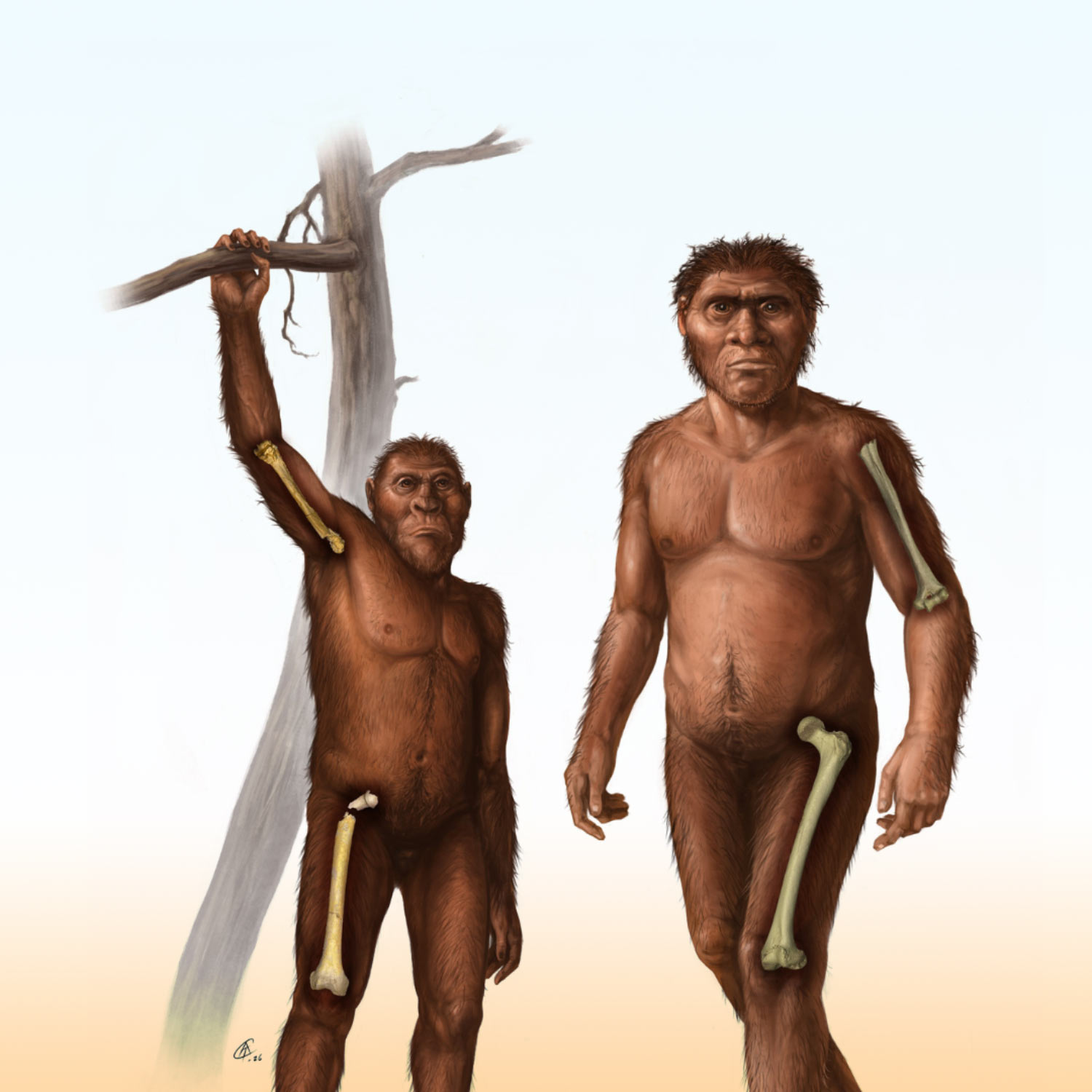
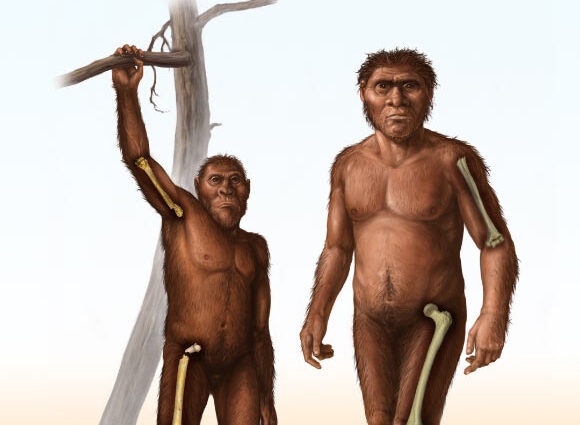
A depiction of an early Homo (right) characterized by relatively greater bone strength of the femur in the thigh compared to the humerus in the arm, and a depiction of an older human ancestor, Australopithecus (left), characterized by more equivalent strength in the bones of the arm and thigh. Image credit: Cullen Townsend.
“Since the time of Darwin and Huxley, terrestrial bipedalism has been posed as a central tenet of the human ecological niche,” said lead author Professor Kristian Carlson and colleagues.
“Considerable subsequent work has been devoted to determining the changing role of this locomotor behavior in the human evolutionary record, beginning with the last common ancestor at the divergence of human and chimpanzee lineages 9.3 to 6.5 million years ago.”
“This cumulative body of evidence portrays a gradation of the selective importance of terrestrial bipedalism: from facultative to habitual to obligate behavior.”
In the study, the researchers analyzed the internal strength of limb bones from two important fossil skeletons: the Little Foot, a 3.67-million-year-old Australopithecus individual from Sterkfontein Cave in South Africa, and a roughly 1.8-million-year-old early Homo individual from Dmanisi, Georgia.
Because bone shafts respond to the physical demands placed on them during life, their relative strength can serve as a record of how an individual actually moved, rather than relying solely on skeletal shape.
The scientists compared arm and leg bone strength ratios in these fossils to those of modern humans, chimpanzees, gorillas and orangutans, whose proportions correlate closely with how much time each species spends in trees.
They found that Little Foot’s limb proportions closely resembled those of African apes, suggesting frequent arboreal activity despite the individual’s relatively large body size for an australopith.
This pattern held even though the same individual’s lower leg bones showed more human-like proportions, hinting at a mixed locomotor repertoire that combined tree-climbing with some terrestrial walking.
“This is one of the most surprising results,” Professor Carlson said.
“The Australopithecus individual has a modern human-like signal within the lower limb, while the relationship between the arm and thigh is much more African ape-like.”
By contrast, the Dmanisi Homo individual displayed limb strength proportions squarely within the modern human range in both measures the authors examined, aligning with earlier evidence from Homo erectus fossils in Africa.
The consistency across these early Homo individuals led the team to conclude that a fundamental shift toward habitual, humanlike terrestrial bipedalism — with arboreal behavior mostly abandoned — was firmly in place by about 1.8 million years ago.
The shift may be linked to changes in foraging strategy and expanded ranging behavior, rather than to tool use, since stone tool production predates the shift by more than a million years.
“The difference may represent a ‘threshold’ between the adaptive patterns of Australopithecus and Homo, similar to other major changes used to distinguish stages of human evolution,” the researchers said.
“What caused the shift remains uncertain. It could be linked to changes in ranging, food gathering and other pressures that favored stronger lower limbs and greater dependence on life on the ground.”
“The change took place during a broad period in which brain size was increasing in the human lineage,” they added.
“We are not saying that one change caused the other. But the timing is intriguing.”
“We hope the possible relationship between changes in limb use, ranging behavior and brain size will stimulate further discussion.”
A paper on the findings was published in the journal Science Advances.
_____
Kristian J. Carlson et al. 2026. Proportional limb strengths signal an adaptive shift in arboreality in early human evolution. Science Advances 12 (38); doi: 10.1126/sciadv.aeh1752
