 Skip to content
“Milan is a city that doesn’t want you to know what it is,” said the writer Charlie Porter. He made this assessment as the Prada show, which kicked off Milan Fashion Week on Tuesday, was about to start. And he’s right: like many big cities, Milan is packed with contradictions.
Nowhere was that clearer than on Friday afternoon, when Demna staged his third show for Gucci, and Loris Messina and Simone Rizzo made their debut at Moschino. Both shows attempted to offer a perspective on authentic Italian style, with Milan’s incongruities as an underlying theme.
At Gucci, Demna said the show would be the first in which his full vision comes into focus. “Gucci stands for being rooted in the desire to belong to a more glamorous world,” he wrote in a letter to the press, “and in the audacity to remake that world in your own image.”
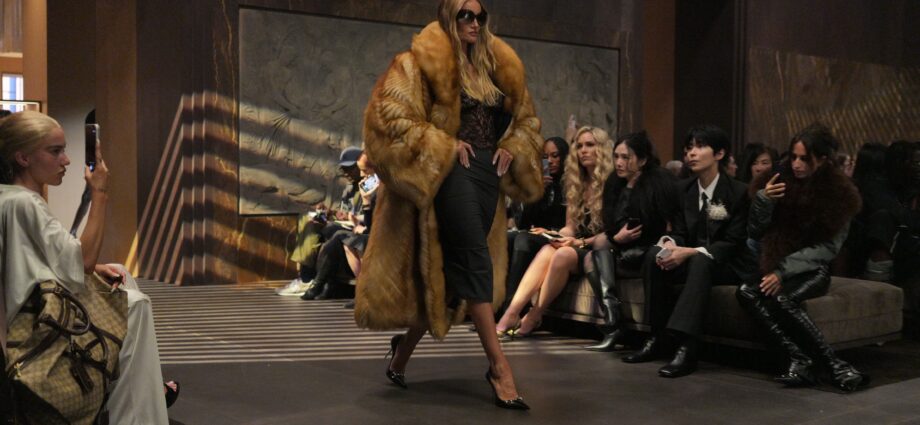
He fashioned his showspace as the ultimate Gucci store, a fun and straightforward gimmick. When else would one be at a store alongside Keke Palmer, Jannik Sinner, and Bianca Jagger? If the idea was to articulate to the press and buyers in the room the retail proposition of Demna’s Gucci, there was no more obvious way.

Gucci: September 25, 2026 in Milan, Italy
Swan Gallet/Getty Images

Part of the Gucci show venue
Courtesy of Gucci
“I don’t think I’ve seen a Gucci store this full in years,” said a writer who asked not to be named. The quip was partly in jest but also a comment on the ongoing financial decline at Kering, Gucci’s parent company, and a slump in sales at the brand.
Perhaps in response, Demna’s Gucci, so far, has been about illuminating its connection to the bourgeois. His first project at the house was a film starring Demi Moore that imagined Gucci as a family business owned by a wealthy matriarch in California. The second, a runway show in February, expanded upon its connection to new money by fashioning buff male models as oligarchs and über thin female ones as their party girl acolytes. Then came an extravaganza on Times Square, which starred ultimate heiress Paris Hilton, on the runway.
This time around, Demna seemed to be speaking more earnestly about glamour and style, and to a customer base that fashion often pretends is not there.
“Gucci moves easily between aristocracy and pop culture,” he wrote, “[between] Florence and Hollywood, good taste and bad taste (whatever that means), heritage and mass desire, belonging and rebellion, and the interplay between the two.”
There’s a multitude of Gucci wearers in the world, spanning bratty aristocrats, the new bourgeois, and lads buying outlet merchandise. All were embraced at this show. It’s clever of Demna to present Gucci as the luxury house with something for everyone, instead of pretending it only sells to the most tasteful. After all, the wealthiest of people don’t always have the best taste.
And yet Demna’s simulation of the real world felt more like a cartoon than an invitation. The show and its meticulous replication of Florentine glamour and the existing Gucci wearer read almost like a meme parodying people with “bad taste,” albeit a successful one.
The staging of the street outside the pretend store with a day’s worth of passers by was a highlight, but the true star was Demna’s cast. A combination of supermodels like Alex Consani and Anok Yai, socialites including Poppy Delevingne and Olympia of Greece, and OG influencer Tina Leung, the assortment of figures grounded the show, and exemplified Demna’s pop cultural prowess.
“I woke up to a message … asking me if I wanted to walk,” Leung said the evening after the show. This was her first time walking a runway of this scale. “Demna’s Gucci is so fucking cunty,” Leung said. “I find it a reflection of our times.”

Tina Leung walking the Gucci show.
Photo: Alessandro Lucioni / Gorunway.com
The first time Leung went to a Gucci show was as a high-schooler in her birthplace of Hong Kong, back when Tom Ford was its designer. At the time, the collection would be shown at fashion week in Milan and then re-shown in Hong Kong when it was about to arrive in stores. “For my high school graduation,” she said, “everyone wore puffy gowns and I wore a Gucci suit.” She still has it.
When Alessandro Michele became Gucci’s creative director in 2016, Leung and her cohort in the earliest generation of bloggers and influencers started attending the shows. “Me, Susie [Lau], Bryan [Yambao, known as Bryan Boy], Tamu [Mcpherson],” she said, were sitting all the way in the back “where the livestream camera hits you in the head.”
“It feels so fabulous to be a Gucci girl,” Leung said. She’s been one for more than a decade.
A model walking the Moschino show.
It was curious that the Moschino show later in the day seemed to have a similar intention, but with an entirely different execution.
Messina and Rizzo are known for their outlandish fashion show concepts at the brand they founded, Sunnei. For their first runway show at Moschino, they cast hundreds of Milanese people, all dressed in their own clothing. The show opened with those people walking right to left, as the collection’s models walked against the crowd, left to right. It was a different version of the street than Demna’s, and a more literal one. This wasn’t about sending the world through the looking glass, but about bringing the outside world onto the runway.
“I am really good friends with people from Sunnei who moved to Moschino with Loris and Simone,” photographer and art director Giacomo Cabrini said, “and they invited me to walk the show.”
“I thought it was a really cool Milanese moment,” he continued, “[Loris and Simone] are always really successful at portraying a side of Milan that is rarely shown to the media. They have a really genuine and authentic community.”
Another cast member, Elisa Carassai, is a writer, editorial consultant, and member of Messina and Rizzo’s creative circle. “I think one of the strengths of Loris and Simone’s concept is that they were able to pull together people who all have different personal styles but are part of the same community,” she said. “It was very representative of the growing, independent fashion community in Milan.”
It was bold of Messina and Rizzo to show their new collection among a sea of interesting people with their own style identities. It made for a clever and engaging show to watch, and established how Messina and Rizzo see Moschino, a brand known for archness and wit. Their version is irreverent, but less conceptual and didactic about its sense of humor.
“Moschino is obviously a historic brand, so it’s been interesting to see how they bring this independent spirit to a heritage brand that has a very ironic point of view,” Carassai said.
“[The show] reflected Milanese style in that it proved the point that there is no such thing as one specific Milanese style,” Cabrini says. “It’s very layered and it’s very complex.” There were people from all over the world in the cast, he says, and of different ages. “It proved the point that Milan is unique in its own way.”
Have you ever wondered what a runway piece looks like in the regular world? Say, a tutu skirt or a bright green gown? At Moschino, you could see it in its natural habitat. While at Gucci, things are more distant. You can only aspire to be a part of Demna’s imitation world.
Unlike Paris or New York, which are exhibitionists and appreciate a certain voyeur, Milan, as Porter implied, resists a single definition. What it looks like depends on which street—or runway—you’re walking down.
-
From Prince George to Princess Leonor: Where Young Royals Will Attend School This Fall
-
The Pitt’s Patrick Ball on Shipping, Stardom, and Season 3
-
From Cowboys to Clean Girls: The State of American Style, in Pictures
