 Skip to content
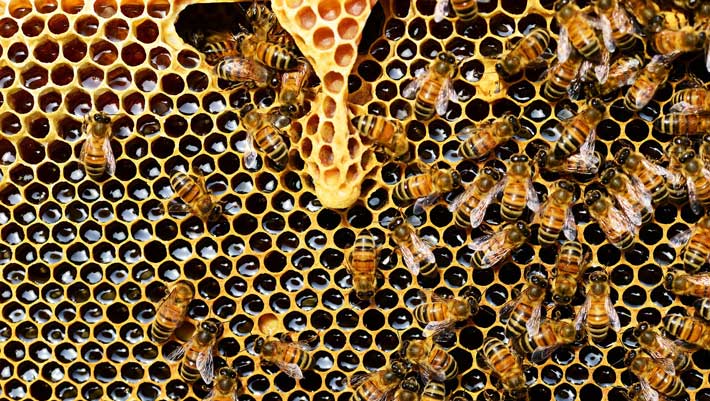
In a new review paper, Dr. Hannes Bonhoff of Lund University and Dr. Heikki Helanterä from the University of Oulu argue that the departing swarm represents the parent colony leaving with its queen, while afterswarms may allow it to produce multiple offspring. They also propose that a honeybee colony is not immortal but a lineage of mortal superorganisms, each with its own distinct life cycle.

Western honeybees (Apis mellifera). Image credit: PollyDot.
Scientists have long considered a honeybee colony a superorganism, a term dating to the early 20th century.
The thousands of workers act like the cells of a body, and the queen is analogous to its reproductive tissue.
The influential American biologist Edward Wilson, in his 1971 book The Insect Societies, treated a new queen as part of the same colony, which made the colony potentially immortal.
Others argued that a colony’s genotype is defined by its queen and the drones she mated with. A new queen carries a different genotype, so a new colony results.
Dr. Bonhoff and Dr. Helanterä side with the latter view. They argue that a change of queen marks the emergence of a new biological individual with a different genetic makeup.
Under this interpretation, what appears to be one enduring colony is better understood as a lineage of related superorganisms that occupy the same nest over successive generations.
They describe the honeybee colony as a superorganism, in which individual bees perform roles analogous to cells in a multicellular animal.
“We have analyzed what it means for a bee colony to be a single organism, which opens up new insights into the fascinating life of the honeybee,” Dr. Bonhoff said.
“The bee colony, as a superorganism, can be likened to an individual mammal that goes through a period of gestation involving extensive parental care.”
“For example, every generation of a bee colony develops from a single bee and progresses through the same stages as a mammal, that is, from embryo and fetus to juvenile and adult, and that this is accompanied by an inevitable biological aging process, which means that the bee colony dies after a few years.”
“When this superorganism reproduces, the offspring are cared for with great dedication by the parent, in some cases even at the cost of the parent’s life.”
Dr. Bonhoff and Dr. Helanterä also challenge the conventional view that swarming itself constitutes reproduction.
Their reasoning is that swarming comes before fertilization, so no new organism yet exists.
Instead, the prime swarm, which includes the old queen, is the parent colony moving to a new home, a survival mechanism that lets the mother outlive reproduction.
Later swarms, known as afterswarms, carry young unmated queens and allow a single colony to produce more than one offspring in a reproductive cycle.
The researchers compare this to certain marine worms that split off reproductive segments before they mate.
“In preparation for reproduction, the sexually immature worm called atoke produces gametes and splits off gamete-carrying sections called epitokes,” they said.
“The latter are temporarily autonomous and go on to reproduce sexually, sometimes involving parental care, but die shortly thereafter.”
“Epitokes are therefore analogous with afterswarms as well as the fraction of the adult superorganism remaining at the original nest.”
“With the release of its gametes to the epitokes, the atoke re-enters a phase of sexual immaturity, where it regenerates its body in order to survive to repeat the process.”
“Similarly, after leaving its egg bees behind, the prime swarm becomes sexually immature with regard to female reproduction and may survive for another reproductive cycle.”
The scientists propose renaming hive roles in the terminology of cell biology: drones become sperm bees; virgin queens become egg bees; laying queens become stem bees, and workers become somatic bees.
In this model, a daughter colony develops inside its mother. Maternal worker bees feed and protect it, and milky food secretions can be viewed as analogous to uterine milk. Over time, maternal workers die off and are replaced by the daughter’s own, until the offspring is fully separate.
According to the authors, this process resembles live birth in animals.
Studies that report the lifespan of wild honeybee colonies, including some tracking how long colonies survive infestations of the Varroa mite, may actually be measuring how long a nest site stays occupied by a succession of different superorganisms.
“Modern beekeeping methods are based on the idea of keeping the colony young and healthy indefinitely,” Dr. Bonhoff said.
“Our study shows that such interventions fundamentally conflict with the natural reproductive strategy and the ability to cope with parasites.”
The researchers also take aim at requeening, the common beekeeping practice of replacing a colony’s queen, often with an unrelated one.
By their logic, requeening kills the existing superorganism and forces it to gestate the offspring of another.
“Requeening does not rejuvenate a colony but kills it,” they said.
“Consequently, conventional practices designed to maximize pollination services and honey production may come at the expense of superorganismal lives.”
The review paper was published in August 2026 in the journal Insectes Sociaux.
_____
H.A. Bonhoff & H. Helanterä. On the life history of the honey bee superorganism. Insect. Soc, published online August 3, 2026; doi: 10.1007/s00040-026-01124-7
