 Skip to content
Does it matter that Blackwood’s label is primarily known for that one social justice statement? Yes, broadly, it does, because it was presumably his objective. But at the White House, not really, because we don’t know if the owner of the handbag was making a point—since she didn’t opt to carry the design with the decisive slogan.
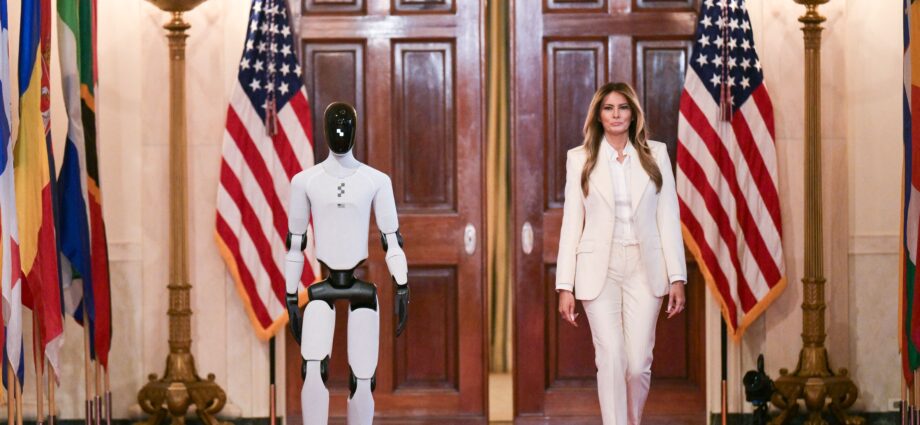
Fashion in politics, particularly in the Trump-sphere, operates this way. Melania herself has seemingly decided not to align her wardrobe with any particular messaging. Her remit, simply, seems to be to look polished, be that in Dolce & Gabbana, which she wears often, most recently when appearing beside the humanoid robot last week, or in custom dresses by her stylist Hervé Pierre. Because the American fashion industry has not partnered with the current first lady, she, in turn, has not embraced it as part of her messaging.
Jill Biden would oftentimes wear American-made fashion by designers such as Jonathan Cohen and Markarian’s Alexandra O’Neill, and even former vice president Kamala Harris made sure to leverage her role to spotlight American designers, including Tory Burch, Prabal Gurung, and Christopher John Rogers.
Melania, on the other hand, does not seem interested in playing that game. (Even if she has been sporting more American labels of late, including the Michael Kors Collection dress she donned last night to attend the opening night of Chicago at the Kennedy Center, which she first sported in 2017.)
She is not alone. If anything, her approach is similar to how many politicians and first spouses have related to fashion historically. That today the expectation is to use fashion for political or social messaging is a contemporary idea that is largely, I would say, American, and one I would credit to Michelle Obama’s influence. In the past, fashion was about nothing other than status: ambition, access, wealth.
Take Eva Perón, the former first lady of Argentina, who rejected both communism and capitalism by way of a “third position,” Peronism. Above all, she was a fierce ally of the blue-collar working class, known as descamisados. She was also a Christian Dior haute couture client who embraced the designer’s famous New Look during and after a European tour in 1947. (Dior himself is widely reported to have said that “the only queen I ever dressed was Eva Perón.”)
Consider, too, the opulent lifestyle of the late authoritarian Venezuelan president Hugo Chávez, a socialist whose daughters and wife, Cilia Flores, were known for such exorbitant spending that they gave way to the term Boliburgoisie, a portmanteau of the words Bolivarian (after Simón Bolívar, the 19th-century Venezuelan liberator who led the struggle for independence throughout much of South America) and bourgeoisie. Journalist Juan Carlos Zapata coined the term to name the oligarchy that came to exist under the Chávez government, then continued through Nicolás Maduro’s administration and beyond. Cristina Fernández de Kirchner, another former Argentinian president, first lady, vice president, and a self-identified Peronist and Kirchnerist, came to exemplify the widespread brand of 21st-century socialism in South America in the 2000s and 2010s. She did so while wearing luxury accessories, for which she was often criticized.
This is all why, when Katy Perry appeared at the World Economic Forum in Davos next to former Canadian prime minister Justin Trudeau wearing an ensemble by Jacquemus as part of her—pretty effective—pop-star-goes-first-spouse cosplay, I could not help but giggle. For $1,500, you too could play the part. After all, the name on the clothes—or the handbags—doesn’t matter like it once did. Trump has made sure of that.
