 Skip to content

Finding the time and motivation to sit down and practice is hard enough for most musicians. Too often, concentration slips away as soon as you have to get up to look for a pen, a string, a battery, or a cable—and the time you hoped to spend playing starts to evaporate.
For many players, the issue isn’t motivation so much as the setup itself. Practicing in a shared space, searching for gear, or having to reset the room each time you play can pull you out of the moment before you’ve really begun.
Even if it’s just a little corner to call your own, a thoughtfully arranged practice area can make a real difference. Picasso loved his studio at La Californie so much that he included it in his own paintings—many times. What follows looks at a few simple changes that can make your space more comfortable and efficient—and spark creativity.
1. Take Stock
Turn a critical eye to the place where you currently practice. Is it dedicated to your musical efforts, or do you share it with other people or tasks? Does it have enough light? Is it quiet? What are the acoustics like? Is there an interesting view? Is there a door you can close—for privacy or to keep out the howling dog? Do you have a comfortable chair that isn’t constantly buried in stuff? A table or bench for coffee, a book, or your phone? Can you control the temperature? Overall, is it an inviting place to be?
Make a quick list of the things you use every time you play, and the ones you need less often. Include things you have or wish you had: music and guitar stands, metronome, tuner, sticky notes, manuscript or note paper, sheet music and tabs, spare picks, your tablet or computer, mic and stand, recording device, spare strings, cables—anything that supports your practice.
How do you handle music playback: CDs, an audio-slowdown app, the computer? Is the system easy to access? Do you have headphones dedicated to practice?
Finally, take inventory of gear you use infrequently. It might be hiding in a box with shaker eggs, a kazoo, and a couple of tin whistles.
2. Set It Up
Now that you know what you’re working with, organize your space so the essentials are within arm’s reach, and the less-used items are still easy to find. If the acoustics don’t inspire you, consider whether you want a deader space (helpful for recording) or something more resonant. Moving to a different part of the room—or adding curtains or a sound panel—can make more difference than you’d expect.
Keep your everyday guitars accessible on the wall, in a rack, or on a stable stand. Set up your music stand, mic stand, chair, and desk or table so you can sit down and start playing without rearranging the room. Replace wobbly tables or stands with sturdy ones you can write on. Add a better lamp if needed. Make sure you have room for a water bottle, your phone, and a laptop. Many players find there’s never quite enough clear horizontal space—try to plan for that.
It’s also time to tackle those haphazard piles of sheet music, books, tabs, and CDs. Get a few binders plus a three-hole punch or clear sleeves, and file things in a system that makes sense to you.
Consider using a tablet for digital storage. Start small by scanning the music you’re working on right now. Many apps let you organize with folders, keywords, or playlists, making everything portable and easy to locate.
As for cables and miscellaneous tech, take a moment to straighten it out. A quick image search can inspire smart—and inexpensive—storage solutions. Drawers, bins, and boxes all work well if you label them clearly.
3. Make It Yours
This is your sanctuary, so let it feel personal. Add elements that make the space welcoming: posters, a favorite photo from a memorable gig, framed album art, or original artwork. A few intentional touches can shift the whole vibe.
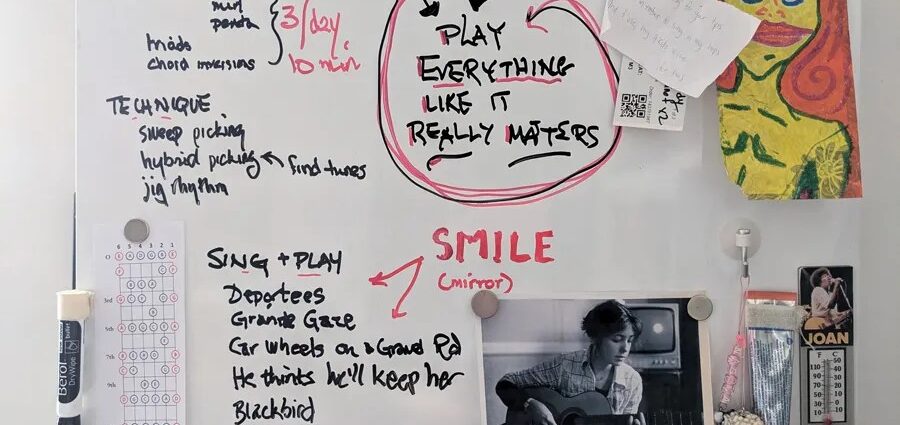
Think about the little things that support your practice—maybe a timer, a space heater, a nail file, or a mirror to check posture. One of my favorite additions to my own space is a small magnetic whiteboard where I jot down current projects, long-term goals, and a few inspirational quotes and snapshots. A quick glance keeps me focused and motivated.
4. Pack Light, Play Anywhere
Finding a satisfying practice setup while traveling can be a challenge, but once you understand your essential needs, it becomes easier to re-create a workable environment on the road. Your guitar, a decent chair, a flat surface for a tablet or sheet music, a water bottle, and a measure of privacy may be all you need for a productive session away from home. You deserve a practice space that’s fully yours—comfortable, functional, and tailored to your needs. It will change as your music changes, but with a bit of intention you can create a refuge that supports and recharges you. And who knows? You might end up loving it so much that you want to make a painting of it.
