 Skip to content
Every recipe we publish at Bon Appétit is the answer to a question that starts with, “What if…”
What if you could make a satisfying beef stew in under an hour? You can—just meatball-ify it. What if you could brine and roast a turkey in parts? It would be the tastiest turkey you ever made. What if you could make a blueberry muffin as a mug cake? Still working on finding out! Before any of our fabulously talented Test Kitchen editors even pick up a knife or whisk, every concept is considered and debated by multiple Bon Appétit staff members. Once we get into what we call development, the recipe goes through several rounds of rigorous tests and tastings. Then there are numerous stages of edits, not to mention a full photoshoot and often a video shoot. It’s a time- and labor-intensive process, but we know from decades of experience that it results in the best, most foolproof, and reliably delicious recipes. Below is the full breakdown of our process from start to finish.
Meet our full team here. And to gain access to thousands (and thousands!) of great recipes from the Bon Appétit Test Kitchen—and use our custom app—please consider subscribing.
Recipe ideation
Every recipe comes from a pitch—that’s industry speak for an idea. Sometimes the inspiration is a seasonal ingredient, holiday, or trend. (Say, summer tomatoes, or sardines for, uh, skin care.) Most often, it’s connected to larger initiatives within Bon Appétit. From regular series like BA Bake Club and Fourth Trimester, to print features highlighting chefs and restaurants, recipes are part of how we bring people and stories to life.
Our catalog has tens of thousands of fantastic recipes, so it’s not that we think you need another way to cook steak. But when it’s got an umami brown butter sauce and why-are-these-so-good greens? Well, we sure want that for dinner, and hope you do too. The same applies to anything we put out there. If it’s a new recipe, we feel confident it will solve an everyday problem or bring some much-needed inspiration and joy to your day.
Recipe development
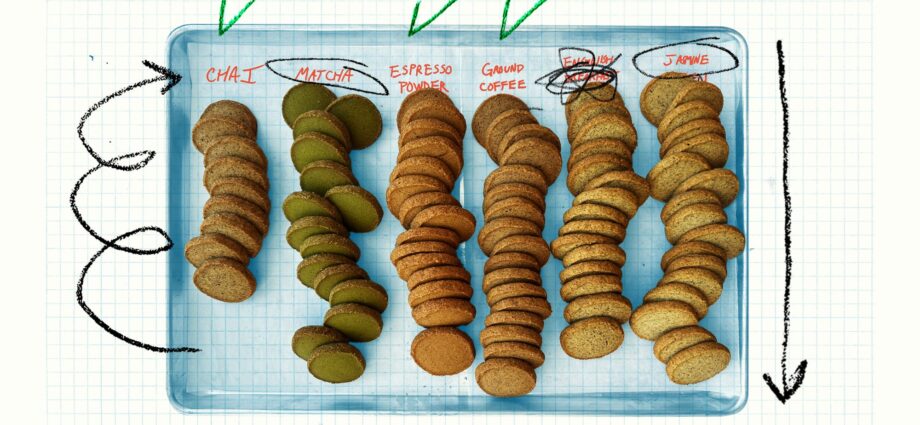
When it comes to cooking and baking, there’s nowhere to hide in the Test Kitchen. While each editor’s style might differ, the expectation is that every version of every dish will be evaluated at tastings, which happen twice per day most days. That means the failures, the what-might-have-beens, and the victories; it’s all valuable. The most important aspect of each tasting is the conversation that surrounds each dish. One person might think a recipe has too many steps or ingredients, regardless of how delicious it is, while another taster might question whether a recipe has strayed from the focus of the story (like a sheet-pan dinner that requires a sauce to be cooked on the stovetop).
It’s also worth noting: Tasting is not the same as eating. (In fact, I will usually eat a light lunch or snack right before most tastings so I go in unbiased by hunger.) Each recipe will be assessed for: How well does it fit the intention of the story it is running with? (For example, if we’re running something under our It’s That Simple umbrella, it really has to be that simple, like a two-ingredient chocolate mousse.) What are the ingredients and steps involved, and can any of those be simplified or reconsidered with home cooks in mind? And of course, how does it taste? How does it look? Everyone offers feedback.
Some recipes might go through just two rounds of development, but I have seen 10 or more, with baking recipes usually requiring the most passes. Even when the first attempt is very good, it is almost always a worthwhile exercise for Test Kitchen editors to try a variation or three, or pit different versions against each other, or simply seek small incremental improvements. All of the knowledge they glean will be useful when it comes to sharing their work with readers. Once the developer and tasters are in alignment, it’s ready for a cross-test.
Cross-testing
At Bon Appétit, every recipe has to be cooked through by at least two editors in our Test Kitchen. If that sounds like a lot of work, that’s because it is. After development is complete, this subsequent round is called a cross-test, and is always carried out by someone other than the recipe developer. Why? It is an objective test drive to make sure that, in other hands, on another stove, using other equipment, the recipe still performs as expected. Almost always something comes up. Say, the need for even clearer descriptions for how long to mix pie dough; or indicating where ingredient swaps are possible, like substituting collard greens for kale in braised greens.
After making the dish exactly as written, the cross-tester will share the final dish and their detailed notes with the recipe developer or assigned Test Kitchen editor. Then the recipe will either be ready to pass off to copy editing, or we’ll do more development and testing. This part of the process can be painstaking, but it catches mistakes and irons out any wrinkles before recipes reach Bon Appetit readers. And that makes it worth it to us.
Editing
We’re not done yet! A perfectly executed dish in the Test Kitchen means nothing if a home cook can’t recreate it. A recipe has to communicate every ingredient and step, from the type of brown sugar (there is a difference between light and dark) to how to fold pie dough for the flakiest layers. Accuracy, specificity, and consistency are paramount, beginning with how each staffer writes their recipes, and in how senior editors edit them. Our recipe copy editors are the last word on the specifics of our recipe language. We have a signature style (that follows a style guide that is many, many pages long), which ensures ingredients appear in the correct order (so you can follow instructions smoothly), and that processes are as clear as possible (for success no matter your skill level). We also have dedicated copy editors and fact checkers who make sure our content is in tip-top shape and as accurate as possible. It’s a lot of cooks in the kitchen, in a good way.
Naming
Naming a recipe is not easy. Well, sometimes it is. In fact, sometimes the name is what propels us toward development in the first place. Chocolate Chipless Cookies, for instance, was locked from the start, and any deviation from that title was not an option. But most recipes could be called many things and our job is to figure out: Which is best? That is, which is most accurate, clear, on-brand, and enticing? Our editors have several conversations over the course of the Test Kitchen tastings and what we call “packaging sessions” on Slack. Staffers from various teams bounce ideas back and forth and discuss the pros and cons of each option.
For us, names typically fall into one of three buckets: straightforward, service-driven, and voicey. Straightforward means we’re telling you the most important elements of the dish—its primary technique and main ingredients; for instance, Roasted Cauliflower Salad With Feta and Dates and Coffee Cake Scones. In a service-driven application, we highlight the benefit—say, 10-Minute Bone Broth Soup or One-Pot Summer Vegetable Pasta. And finally, voicey is arguably our signature at BA. Think Incredibly Good Homemade Pizza or Gorgeous Green Shrimp. We’re having fun!
Photography and publication
We eat with our eyes first. Recipe photos need to look craveable enough to stop you mid-scroll and mutter, “Oooh…” We have an all-star visuals team that brings recipes and stories to life through photography and illustration. Test Kitchen editors sometimes food style their own recipes for photography, but it is more often professional food stylists who cook the recipes as they appear in photos, since it is such a meticulous and time-consuming process. It might take a full day to shoot four or five recipes. Often there will be a food styling assistant, a prop stylist, photo assistant, and a producer on hand to organize it all—it takes a village! Many of those shoots take place in our kitchen studios, meaning an entirely separate team has the chance to cook through every dish, offer us feedback if necessary, and focus on making every recipe look as good as it tastes.
Post-publication
In the digital era, we receive comments in real time on recipe pages and in our app. Of course it is always great to see readers offering praise and encouragement to each other. But it is also an invaluable opportunity for us to answer any questions about ingredient swaps and technique adjustments, and hear about any issues that might arise. Let us know how it goes! We want to hear it all.
When I started working at Bon Appétit in 2011, we were primarily a print magazine that had inherited a wonky set of Test Kitchen spaces (with no windows!) in our old headquarters in Times Square. So much of the content we do now—like our downright famous no-knead focaccia and reader-favorite classic chocolate chip cookies—didn’t exist then. Yet the way we develop and edit recipes is mostly unchanged. Why? Because we know it works.
