 Skip to content
Get the Popular Science daily newsletter💡
Breakthroughs, discoveries, and DIY tips sent six days a week.
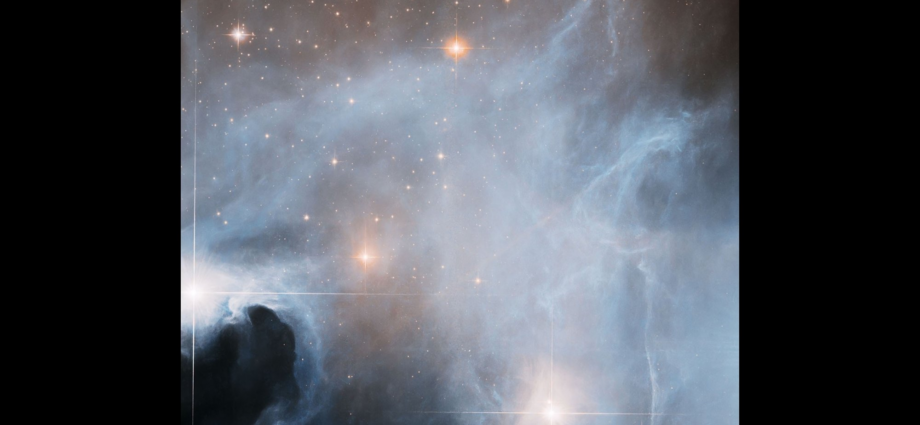
NASA’s Hubble Space Telescope has captured a trio of young stars in the process of becoming their best selves in the constellation Scorpius. Posted to the agency’s site on January 16 as part of its Hubble Stellar Construction Zones series, the three T Tauri stars—seen at the bottom right, upper center, and left along with many other stellar objects in the background—are forming inside the hazy Lupus 3 cloud about 500 light-years from Earth. While the image appears somewhat serene, the interior forces at play are anything but tranquil.
A T Tauri star is a young star, usually less than 10 million years old. During this phase, the still-growing stellar object sees the dust and gas surrounding it begin to disappear as stellar winds, radiation, and other ionized particles bombard it. This dynamic environment is reflected in the star’s brightness, which randomly fluctuates depending on the material interactions underway in its accretion disk. More regular shifts in brightness can also occur as sunspots move in and out of view to astronomers here on Earth.
The T Tauri examples seen in Hubble’s image have a long way to go before they resemble the stars most observers recognize. Gravity will continue to bear down on the object until it forces hydrogen and helium elements to fuse in the star’s core, at which point it will finally become a main sequence stellar object.
The stars in Scorpius are further along in their growth than the protostars highlighted by NASA on January 14, however. About 1,300 light-years away, protostars in the “sword” of Orion are getting their start inside the constellation’s Orion Molecular Cloud complex. Astronomers aimed Hubble toward this area of the sky to better understand outflow cavities—areas where a protostar’s gas and dust is shaved away by nearby stellar winds.

2025 PopSci Best of What’s New
The 50 most important innovations of the year
