 Skip to content
As another New York Fashion Week came and went, border czar Tom Homan said on Thursday that the US immigration enforcement surge in Minnesota, which led to the killing of Alex Pretti last month and an insurmountable amount of violence, would conclude. Meanwhile, the Department of Homeland Security is shut down due to a lapse in its funding, with lawmakers at a standoff over a proposal to restore it as Democrats seek restrictions over President Trump’s immigration measures.
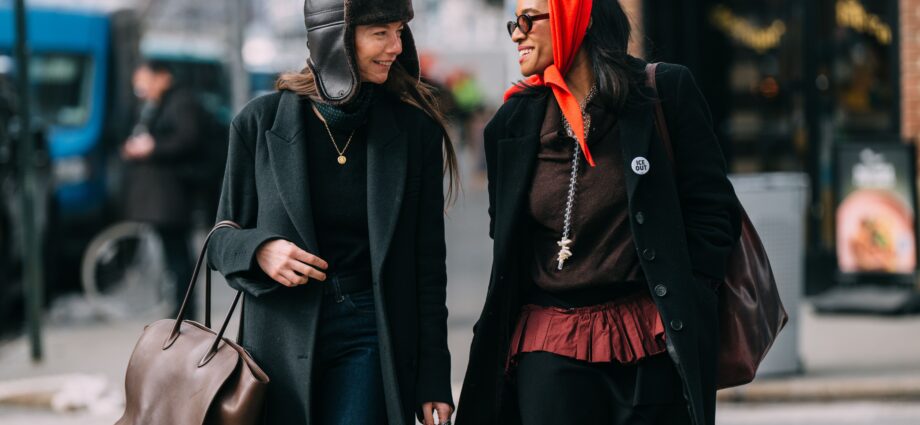
Amid the opulent parties and invite-only runway shows of fashion week, it could be easy to ignore the tensions going on throughout the country. But a collective effort by parts of the industry has looked to burst through that invisible barrier. The American Civil Liberties Union (ACLU) partnered with designers, magazine editors, executives to activate around the “ICE Out” campaign that condemns the ongoing immigration crackdown and the killings of Pretti and Renée Good by wearing pins with the title slogan.
But surely there’s more fashion can do than wear a button, right?

A guest at New York Fashion Week.
Christian Vierig/Getty Images

A New York Fashion Week attendee.
Christian Vierig/Getty Images

A New York Fashion Week attendee.
Edward Berthelot/Getty Images
In the past, the industry has engaged with politics primarily with a message to register to vote—a somewhat tepid initiative that waves a bipartisan white flag in order to not alienate potential consumers. This season, despite the fact that it’s a midterm election year, saw the majority of the industry avoid any political discourse, with few exceptions. Hillary Taymour of Collina Strada, Henry Zankov, Christian Cowan, Patricio Campillo, Rachel Scott of Diotima and Proenza Schouler, and Rio Uribe are among the designers who wore the pins at their runway shows. Scott and Uribe also addressed the political landscape both as part of their collections and while speaking with reporters. “If you have a platform of any form, you need to be saying something about what’s happening,” Scott said after her Diotima show on Sunday, “especially in fashion, which operates in the realm of culture.”
These pins are, by design, “an entry point into other things,” says Jess Morales Rocketto, the director of Maremoto, an organization and fund dedicated to amplifying Latino storytelling, who created the pins with her friend and co-organizer Nelini Stamp, director of strategy at Working Families Power.
The campaign itself came together immediately following the Good’s killing in January. “It was the week or a few days after Renée Good was murdered by ICE, and the video was kind of everywhere,” says Stamp who, together with Morales Rocketto, plus partners at the ACLU and the National Domestic Workers’ Alliance, got to work, quickly. “The Golden Globes were happening and we thought we could get a pin on the carpet as a symbol of solidarity,” she says. Once the pins were created, they deployed an assortment of Hollywood contacts—agents, celebrities, and more—to bring them into the Golden Globes. “People had pins in their purses to give out. It was grassroots,” Morales Rocketto says.
It’s how Ariana Grande ended up wearing a pin at the ceremony, which was handed to her by Mark Ruffalo. “After the earned media response was, I would say a little surprising to us, “we knew we were onto something, “ Morales Rocketto says.
Later in the month, Hollywood descended into Utah for the Sundance Film Festival and the “ICE Out” pins made their way to the likes of Natalie Portman, Olivia Wilde, Zoey Deutsch. “The interest was crazy,” says Morales Rocketto. And then came the Grammys.
“That was the tipping point because politics were all people were talking about,” Morales Rocketto says. Billie Eilish, Finneas O’Connell, Carole King, Joni Mitchell and other attendees donned the pins as winners including Bad Bunny and Olivia Dean spoke about immigration during their acceptance speeches onstage. The next step was to reach beyond Hollywood. Enter: New York Fashion Week.

Billie Eilish, Carole King, and Finneas O’Connell at the Grammy Awards.
Kevin Mazur/Getty Images

Patrick Milligan and Joni Mitchell accept the Best Historical Album award at the 2026 Grammys.
Frazer Harrison/Getty Images

Lisa and Ariana Grande at the Golden Globes.
CBS Photo Archive/Getty Images

Justin Bieber and Hailey Bieber at the Grammys.
Kevin Mazur/Getty Images
The organizers were connected with the Council of Fashion Designers of America (CFDA) by the ACLU, plus Aurora James, founder of Fifteen Percent Pledge, and consultant Nicolette Mason. Pins were sent to New York City to industry partners—editors, producers, designers, and more—who’d help distribute them throughout the week.
The CFDA, which acts as the American fashion industry’s governing body, informally connected designers with organizers. (The CFDA remains nonpartisan as a 501(c)(3) non-profit organization.) “New York Fashion Week has always reflected a range of perspectives. Some brands engage directly with cultural or political conversations, others prefer to let the work speak for itself,” the CFDA said in a statement provided to Vanity Fair. “That mix changes season to season and is part of what defines the American fashion community. The CFDA’s role is to support designers and provide the platform. How they use it is up to them.”
One of those designers, Campillo made a splash a year ago at his first NYFW show when he closed his presentation wearing a “Golfo de Mexico” tee. This time, the Mexican designer stepped out for his bow at the end of his show wearing an ICE Out pin.
“I wore the pin because having a fashion show is a platform to communicate important issues, and it’s important to advocate for tolerance, acceptance, and spread a message of love rather than hate,” Campillo says. “The American fashion industry profits from immigrant labor and culture. Staying silent is complicity. As an ‘immigrant’ designer, this is not abstract to me; it is personal.”
Many of the designers on this past week’s schedule are immigrants or first generation Americans too, a number that’s only continued to increase as fashion has become less exclusionary to break into. “I came here to America as a refugee and immigrant with my whole family,” Zankov says, “This entire country is built on immigrants, that’s actually where the culture comes from. The industry itself is also so propped up and built on immigration from day one. As designers and business owners, it’s our responsibility to speak up.”

Henry Zankov
Estrop/Getty Images

Patricio Campillo

Hillary Taymour of Collina Strada
WWD/Getty Images

Rachel Scott of Diotima and Proenza Schouler
Victor VIRGILE/Getty Images
“It’s not an accident that you have younger, more diverse, more outspoken designers that are saying yes [to engaging with this campaign],” Morales Rocketto, “it’s reflected in the clothes that they make, and of course then it makes sense that you would make a statement.”
“The fashion industry is so incredibly powerful,” says Morales Rocketto. “It’s in New York City, one of the most immigrant-heavy places in America, and it’s an industry that’s powered by immigrant labor. It’s not possible to have these shows, these labels, without immigrants.”
This changing of the guard extends past designers, too. Attendees who wore the pins, the majority of which were millennials and zoomers, ranged from casual guests to industry heavyweights, including next generation editorial leaders at Vogue, Harper’s Bazaar, Teen Vogue, i-D, and Nylon. “Of course there’s something about celebrities and the red carpet, but it’s gratifying and exciting to see fashion week attendees [wearing the pins] because these are people who are engaged in the business,” says Morales Rocketto.
Still, the industry has an opportunity to go deeper than just pins.
Fashion houses, despite the connotations of glamour and excess, are workplaces that heavily rely on immigrant labor, particularly those that produce either samples or retail stock in the New York City’s Garment District. These businesses can become what’s known as Fourth Amendment workplaces, explains Morales Rocketto, which in turn means that they don’t cooperate with ICE or local law enforcement.
“If American fashion wants credibility, it must stop treating immigration as a trend and start defending the people who make the industry exist,” says Campillo, “through protection, opportunity, and public advocacy.”

Attendees at New York Fashion Week
Edward Berthelot/Getty Images

Street Style during the Fall 2026 New York Fashion Week on February 12, 2026 in New York, New York. (Photo by Jason Jean/WWD via Getty Images)WWD/Getty Images
That so much of the American fashion industry is based in the city only makes its engagement on these issues more important, Morales Rocketto suggests. “The Senate minority leader is from New York,” Morales Rocketto says of Chuck Schumer, “if the fashion industry says to him that it is a priority to them that he does not give more money to ICE, and that it is a priority to them that he supports immigrants by keeping them safe, that makes a huge difference.”
For her latest collection for Diotima, Scott, who is an immigrant from Jamaica, worked with the Refugee Atelier, an organization in the city that supports skilled immigrant women with finding work and stability. These kinds of partnerships are what Morales Rocketto is talking about when she says that it’s crucial to support immigrant founders to change the landscape of the industry and therefore the labor opportunities it can provide.
“I don’t think that that’s DEI, I think that’s actually an acknowledgement that fashion is and has always been powered by these techniques and ideas and fabrics that have started with our community,” Morales Rocketto says, “and so it needs to go back to us.”
-
Margaret Qualley on Gossip, Surrender, and Life With Jack Antonoff
-
Wuthering Heights Is Weird. Emily Brontë Was Even Weirder
-
How Epstein’s Ghost Is Calling All the Shots in Trump’s White House
-
The CEOs of Kalshi and Polymarket Are Betting On the Most-Hated Experiment in Business
-
The New Epstein Files Are Reopening the Pizzagate Box
