 Skip to content
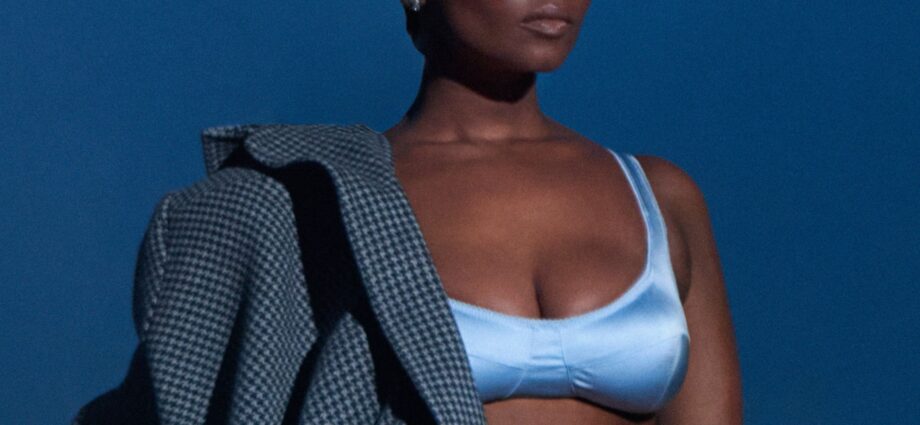
When Kelela released “idea 1,” the lead single from her latest album, New Avatar, it was clear she was entering a new sonic era. The artist’s fans—Kelelians, if you will—have come to associate her with sultry R&B vocals layered over experimental electronic production.
But “idea 1,” with its guitar-forward sound and visuals of Kelela sporting icy white hair and bleached brows, feels less like a departure than a homecoming. Long before Cut 4 Me or Take Me Apart, Kelela got her start in an indie band called Dizzy Spells, whose music has all but disappeared from the internet (there’s only a nonworking Myspace page); and one of the songs on New Avatar was co-written with her longtime collaborator A.K. Paul more than a decade ago. Originally intended for Take Me Apart, the track was shelved after creative differences with a producer led Kelela to take that album in a different direction.
In conversation with Vogue, Kelela reflects on why now felt like the right time to embrace her indie-rock roots, collaborating with Fousheé and PinkPantheress, and how her evolving sound is shaping the way she thinks about fashion.
Vogue: If your previous record, Raven, was about setting boundaries, what is New Avatar about?
Kelela: I would say Raven was giving boundaries. This is also giving boundaries. I am not saying anything wildly different on this record. I would just say maybe I’m saying it with more conviction. It’s giving, “Listen. I’m not gonna play anymore. I’m not enticing you into this, okay?” I’m not being like, “Come on.” It’s not giving that. It’s giving, like, “Get over here! You get on my nerves!”
You wrote “outta time” with A.K. Paul 10 years ago. What was it like to hold onto that song for that long?
I would say that it feels stamina-building. I feel like my patience is strong. I just feel a lot more comfortable about taking my time. And there is a really good time for something. I love that I waited till now because it does feel like the right record for it to live on, and it also feels like the right time. For me as an artist, the groundwork that I have laid up to this point, I think that there’s some way that it’s landing differently than maybe it would’ve landed before. But then I think the other aspect of that is that people externally are more primed for that song as well in certain ways.
That song references some things that happened a long, long time ago. It’s very true that there is so much more music right now that feels like it wants to go there, maybe more than it did 10 years ago.
In addition to A.K. Paul, you have some fun features on this album. I was thrilled to see you collaborate with PinkPantheress again, and it was great to see Fousheé. What was it like working together?
With PinkPantheress and Fousheé, I’m trying to choose people I respect and trust as a starting point—their lens, their vision for themselves, their scope. I trust their taste. I played Fousheé a couple other songs, more guitar-forward songs. And I was thinking, like, maybe she would want this. And I also played her the song that she’s on, which is more dance-y. She’s like, “Oh, I wanna get on this.” And I was like, “Oh, I love that you chose that.” And then she slid in like 20 minutes.
I peeped a sneaky La Chat sample in “idea 1,” which made me curious: Is there any other “ear candy” on the album that you want to share with fans?
The clue is: “You know what?”
What were you listening to in preparation to make the album?
I was revisiting a lot of music that I had listened to in a more formative time for me. I made a playlist called “White Bag,” because I was like, I’m about to get in my white bag. And it’s not about all guitar being a white thing, but socially, there’s an implication. There’s just a way that white people also rate you more when you pick up a guitar. Like Metric, Morning View by Incubus, this band called Buke and Gase , and the Fiery Furnaces that I used to be really obsessed with. Laura Marling was on there. It’s an important playlist. As soon as I told my friends, they were like, “Um, excuse me, Kelela. I’m making my own ‘white bag’ playlist.”
I want to talk about fashion quickly. With this album reflecting a sonic shift, will that also show up in what you’re wearing on stage?
I worked with Yasser Abubeker on creative direction for this record, and I told him I really wanted it to feel situated in New York. I would say, for myself, I just wanted to say something about the place I actually live in and the context of my real, everyday experience. And there are several moods that I’m embodying during any given week, you know? There’s, like, sweatpants going around the corner to the coffee shop. But it’s still a “stomp.” There’s also a lunch moment. I would say, like, there’s a little SoHo shop or stomp moment. There’s, like, a Chinatown walk. There’s a runway happening kinda all the time in New York. They’re just different runways.
I still think about some of your looks with Maximillian Davis, like the hooded orange look you wore a few years ago at your BRIC concert at Prospect Park.
That Farragamo look—he tore that. He’s so talented. He has so many brilliant ideas. And it’s stuff that I want to wear. He just knows how the girlies want to feel. I’m down for a suit, and I love clothes that are structured and make me feel that way. But he does such a good job of making us feel comfortable, like physically comfortable. Some of the silhouettes, like even what I’m wearing on the cover of In the Blue Light, it’s another one of those moments that kind of feels like, damn, that looks so easy. I think that’s just very cool, to do something like that at a heritage brand like Ferragamo. He tore it out.
You always release a remix album. Do you already have remixes assigned for New Avatar? I’ve heard DJs playing remixes of “linknb” in the Brooklyn clubs!
Not yet. We make a long-ass list of all the people we might want to make a remix. That’s the purpose of the remix project, is to big up people who are incredible but maybe exist in the underground and aren’t as visible as I think they should be. And to especially put young Black people on to other young Black producers and artists. So we shall see!
This conversation has been edited and condensed.
