 Skip to content
Melania and the Tradwife Bot
The robot known as Figure 3 can do laundry and chores. The Trump administration wants it to homeschool your kids.
Enter your email to receive alerts for this author.
Sign in or create an account to better manage your email preferences.
Sign up for the Slatest to get the most insightful analysis, criticism, and advice out there, delivered to your inbox daily.
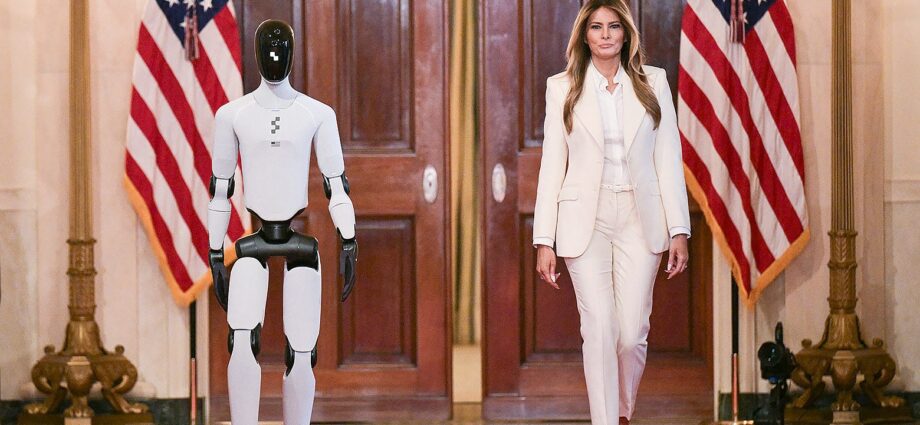
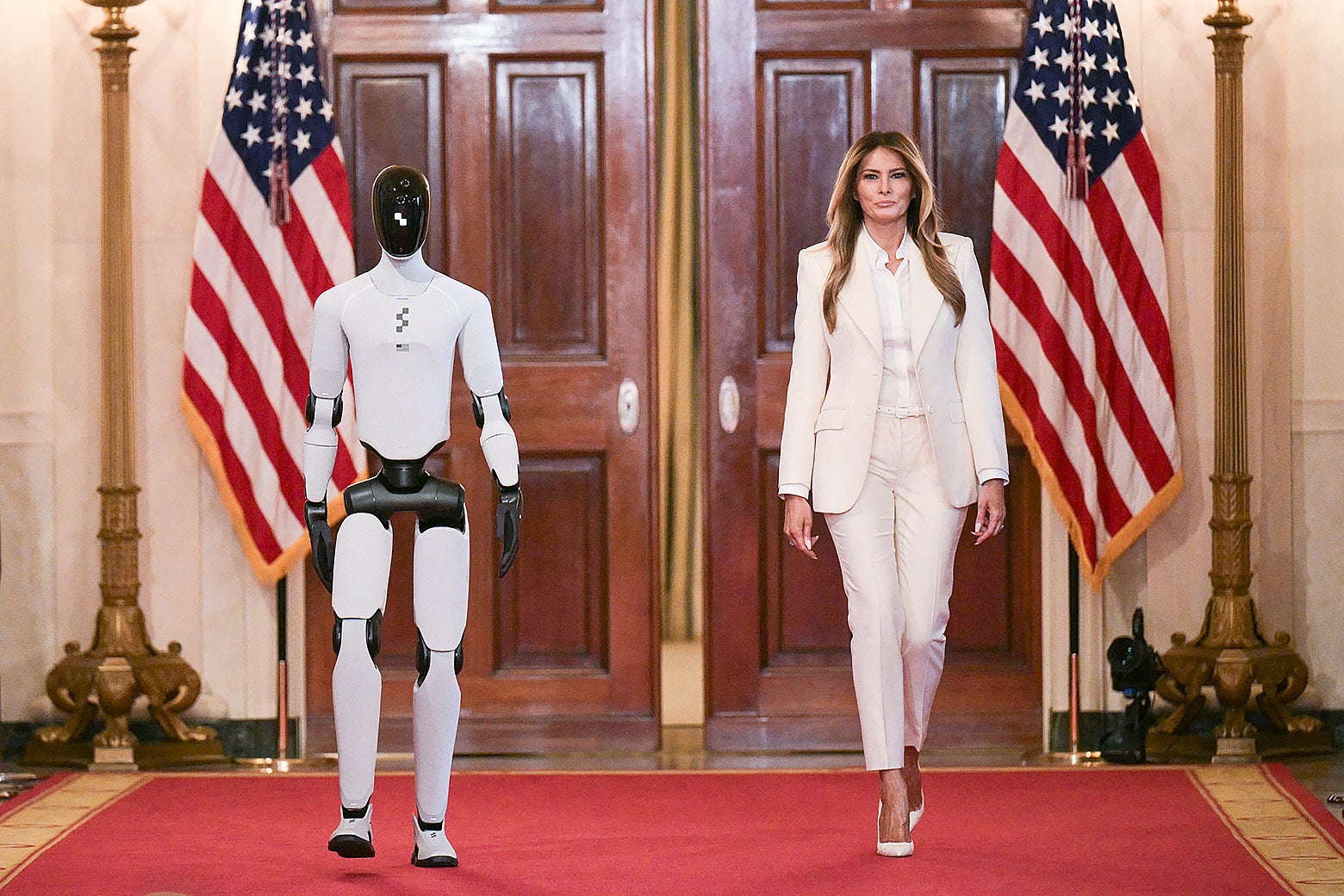
Yesterday, at a meeting at the White House, first lady Melania Trump entered the room alongside a tall, slim, beige-and-black humanoid robot. (Get your “How can you tell which one is which?” joke out now! There—feel better?) The robot introduced itself as “Figure 3, a humanoid built in the United States of America,” and told the group, the Fostering the Future Together Global Coalition, that it was “grateful” to be “part of this historic movement to empower children with technology and education.” Melania followed the robot in making comments of her own, telling the audience that the “future of A.I. is personified … it will be formed in the shape of humans.” Then, speaking to the audience that included first spouses from Israel, Ukraine, and France, she described what a humanoid robot like this one might someday do for children.
“Imagine a humanoid educator named Plato,” the first lady prompted the assembled group. “Access to the classical studies is now instantaneous. Literature, science, art, philosophy, mathematics, and history—humanity’s entire corpus of information is available in the comfort of your home,” she said, apparently nodding to the many among the MAGA faithful who have adopted or are contemplating adopting homeschooling, often using curricula branded as “classical.” “Plato will provide a personalized experience adaptive to the needs of each student,” Melania promised.
The first lady seemed to pre-acknowledge critiques from people who might wonder whether a robot teacher could really substitute for the human experience of the classroom: “Plato is always patient and always available. Predictably, our children will develop deep critical thinking and independent reasoning abilities. … The A.I.-powered Plato will boost analytics skills and problem solving and adapt in real time to a student’s pace, prior knowledge, and even emotional state.” Above all, Melania argued, the educator Plato would be efficient, hitting notes often struck by homeschool advocates who say they can get more done in fewer hours than a public school: “The byproduct, a more well-rounded lifestyle for our children, freeing up time for being with friends, playing sports, and developing interests beyond school.”
It’s important to note that “homeschool tutor” isn’t a role that “Figure 3” can currently fill, but rather an idea of one it may be able to fill in the future. Its maker, Figure AI, advertised this model on launch as a household robot that could carry out tasks like “laundry, cleaning, and doing dishes.” But the Trump administration could be forgiven for thinking that its faithful might enjoy hearing about these teachers of the future, who could (as some happy MAGA die-hards on X indeed celebrated) allow more people to homeschool, completely replacing the “woke” public school teachers who insist on “pushing” social-emotional learning and various other progressive “agendas.” Plato would never end up on Libs of TikTok’s naughty list, because Plato would, the implication is, do only and exactly what the parents of its students want. A teacher, in this future, would become just another tool of the nuclear family, enabling the parents to exercise their right to create a world for their children that aligns completely with their values. After all, a robot can be programmed—by you.
But other parts of the online response to the idea of Plato show that the choice to spin a science-fiction fantasy about a robot teacher is an instance of Melania not, as one education journalist wrote on X, doing a great job of “reading the room.” “Well, this is how you turn me into an anti-Trumper,” wrote one self-identified “Christian” in a quote-tweet of the American Conservative’s coverage of this event. “I love FLOTUS but this is a No from me,” another account with #IAmCharlieKirk in its bio tweeted. “If you cannot loudly and firmly resist ‘humanoids’ called Plato teaching our youth, you have no place in any movement that calls itself ‘classical,’ ” wrote philosopher Jennifer A. Frey, in a somewhat more serious vein. (The growing number of homeschool curricula and charter schools offering “classical education” often, though not always, appeals to conservative or religious parents.)
This response to the idea of Plato shows how mixed up the politics of ed tech have become. The introduction of Plato comes as the backlash against the use of screens and educational technology in schools has begun to get real on the left and the right, as veterans of domestic screen-time battles compare notes and realize that their kids are (to pull a few anecdotes from a much-shared New York Times article from earlier this month) learning the conventions of YouTube videos through seeing them in class, watching videos of books being read instead of hearing a teacher read them, and finding backdoor ways to watch YouTube Shorts on school laptops. Technology in education, as historians like Audrey Watters have been warning for years, always arrives making utopian noises—1-to-1 laptops and iPads will fix inequality!—and leaves behind mixed results.
Just as Melania touted Plato, more people are finding themselves skeptical of ed tech. Earlier this year, senators at a hearing on technology in schools heard two advocates argue for rolling back 1-to-1 policies altogether. As that Times article noted, the backlash against the omnipresence of iPads and Chromebooks in public school has resulted in lawmakers in the reddest and the bluest states—Massachusetts, Vermont, Missouri, Utah—putting together legislation aimed at limiting or revising the use of ed tech in schools, and mandating the teaching of analog skills like cursive writing. Medium-size X accounts with otherwise very Republican-leaning posting histories are writing things like “We need Chromebooks out of classrooms NOW.” Screeds against the K–8 math and reading assessment and instruction platform iReady are going up in heterodox places, like Unherd and the X accounts of school-choice advocates. Yes, there are private schools charging lots of money to offer kids 1-to-1 instruction with A.I. (one was recently graced with a visit from Trump’s Secretary of Education Linda McMahon), but there’s also an elementary school in Michigan that, responding to this foment of anti–ed tech sentiment, recently eliminated all screens from its classrooms in one fell swoop, giving its teachers one week notice.
Could a robot teacher like “Plato” be better than a Chromebook? Maybe, but people who lived through the pandemic’s “Zoom school” era are now much more skeptical than they once were of ed tech’s promises. The Trump administration hasn’t shown much evidence lately of message discipline, and may not care that some conservatives find the idea of a robot teacher to be ridiculous at best, and anti-human at worst. But if anyone’s listening, note to Melania: Not everyone welcomes our teacher overlords.
Get the best of news and politics
Sign up for Slate’s evening newsletter.
