 Skip to content
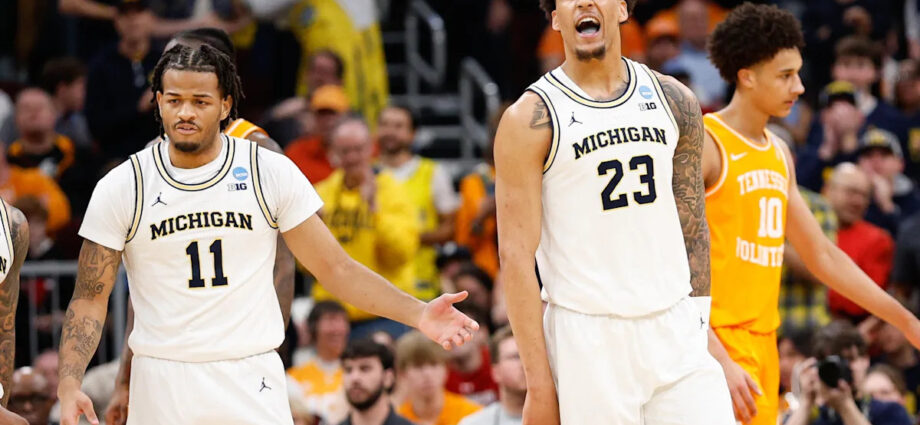
CHICAGO — Even back in November, when the nascent college basketball season was barely a ripple on the national sports radar, Michigan and Arizona were eying each other like boxers in opposite corners, waiting for the bell to ring.
Though their paths did not cross, they were practically mirror images, their dominance made obvious by the wins they were racking up against quality teams — often by big margins. As far back as Thanksgiving week, when Michigan polished off the Players Era tournament with a 40-point win over Gonzaga while Arizona had already banked wins over Florida, UConn and UCLA, it would not have been a hot take to suggest they would be on a collision course for the Final Four.
Advertisement
“There were glimpses of this happening,” Michigan athletic director Warde Manuel said Sunday amid the net-cutting celebration at United Center, where the Wolverines had dominated Tennessee, 95-62. “But there was a long season.”
A long season that will end much as it began: With the two teams who flashed the earliest Final Four potential facing each other in the Final Four.
“We always wanted to play against that team,” Michigan forward Yaxel Lendeborg said. “That’s what everybody goes to college basketball for, to play those blockbuster-type games. They got a bunch of NBA guys. We got a bunch of NBA guys. It’s gonna be a fun matchup, man, and I hope everybody’s ready to play because I am.”

Yaxel Lendeborg and the Michigan Wolverines have won every game this NCAA tournament by more than 20 points. (Kamil Krzaczynski-Imagn Images)
(IMAGN IMAGES via Reuters Connect / REUTERS)
Is it the de facto national championship game? That’s probably unfair. UConn and Illinois, who will be paired in the other semifinal, are excellent teams.
Advertisement
Should the Final Four be reseeded? Now that’s a good debate topic because it certainly appears that the two best teams — and the two best teams all season long — are going to be playing Saturday night rather than Monday.
How hard is it to be as good as Michigan and Arizona from start to finish? Well, you saw it Sunday when Duke, the overall No. 1 seed, melted down in the second half against UConn.
College basketball deciding its champion with a single-elimination, six-round tournament has long been the sport’s blessing and curse. It makes the stakes of every game sky high and creates Cinderella storylines out of nowhere. It also means the national champion is sometimes not the best team but rather the team that got hot at the right time and avoided bad luck or injury. The uniqueness of March Madness has made that tradeoff worthwhile.
But thanks to Michigan and Arizona making it this far, there will be no such caveats this year.
Advertisement
Even before conference play began, you could have reasonably watched those two teams shred everyone in sight and conclude they were on a level above everyone else.
This wire-to-wire trend, however, goes against much of what we’ve learned over the decades about college basketball. Sure, there have been a handful of outlier teams that were locked and loaded from the beginning, but coaches have generally looked at the season as a way to prepare and peak for March.
When a team flashes national championship potential so early the way Michigan did — there was a 10-game stretch in November and December when the Wolverines were beating teams by an average of 34.5 points, including some true quality opponents — it’s almost problematic.
“The most difficult part is that everyone starts getting so much more attention, advice — literally everything they get more of,” Michigan coach Dusty May said. “And it’s difficult not to make it about you because the people you’re talking to are making it about you. There’s just a lot of distracting information, and if you’re not mature and you’re not connected to this group and not willing to be held accountable by the staff and each other, then it’s not going to work.
Advertisement
“And once it creeps in, it’s almost impossible to weed it out. So our guys never let it in. And trust me, they all had different fires that were ignited.”

Brayden Burries and the Arizona Wildcats haven’t lost since Feb. 14. (Eakin Howard-Imagn Images)
(IMAGN IMAGES via Reuters Connect / REUTERS)
If you lump this tournament in with last year, where all four No. 1 seeds made it to the Final Four, it seems like we may be moving away from an era of parity in college basketball and toward a cluster of superpowers. Michigan won its four tournament games by an average of 22.5 points, while Arizona’s margin was 20.5. Neither faced a true second-half challenge on their way to winning their regional.
Tennessee was a top-15 team in the predictive metrics and not some overachieving mid-major, but it was almost comical how overmatched the Vols looked trying to generate decent offense against this Michigan squad.
Advertisement
“Some teams have a little more room for error than others,” Tennessee coach Rick Barnes said.
In a way, college basketball and college football have switched roles in the NIL era. Whereas there used to be no parity at all in college football because of how stacked the superpowers like Alabama and Georgia used to be, conference commissioners are now talking about expanding the playoff beyond 12 because we might be leaving out viable teams.
Meanwhile, March Madness has played out pretty true-to-form for two straight years.
It’s hard to know exactly what to make of that. You can point to the transfer portal and the ability for a program like Michigan to go get an established star like the 23-year-old Lendeborg out of UAB, but here’s Arizona with three freshmen in its starting lineup. Perhaps there’s something to the idea that teams like Michigan and Arizona, which play big frontcourt lineups and don’t rely on making a bunch of 3-pointers to win, aren’t as susceptible to being upset.
Advertisement
Still, college basketball programs are judged by what happens in March. And we have decades of history telling us that it’s extremely hard, and rare, for two teams to be on a collision course all season and actually end up playing each other in the Final Four.
“This was obviously one of the goals because of the talent we had,” May said. “We have a sign in our locker room — “April Habits” — and from Day 1 we’ve challenged these guys to develop championship-level habits that would allow us to win a Big Ten championship and would also allow us to turn the calendar from March until April. Now we put ourselves in position to do that.”
Advertisement
Even though Michigan and Arizona showed four months ago that they were probably on a level above almost everyone else in college basketball, there was no guarantee they’d actually get to settle it on the floor. So many obstacles to overcome and landmines to avoid.
But they will finally touch gloves next Saturday in Indianapolis. Let’s get ready to rumble.
