 Skip to content
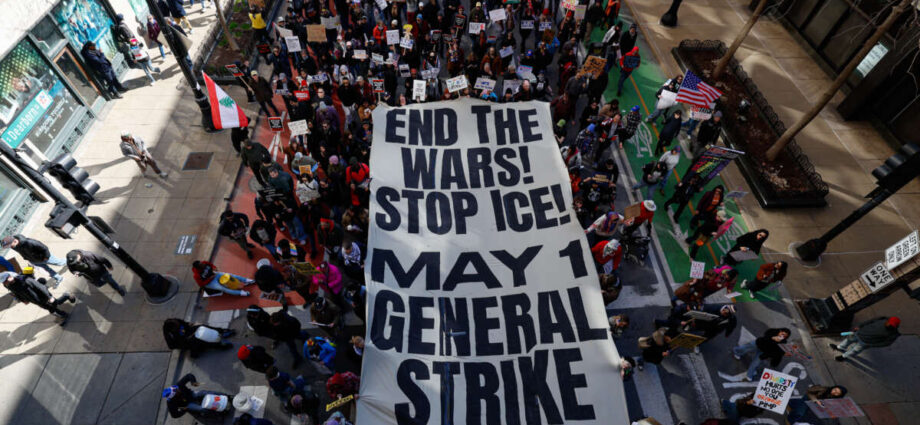
As I headed to my local “No Kings” protest on March 28, I tuned in to the livestream of the far right Conservative Political Action Conference (CPAC) to listen to a man who is currently cheering on a war in order to rule as a monarch over my homeland.
“Can you imagine Iran going from ‘Death to America’ to ‘God bless America?’” Reza Pahlavi, the son of Iran’s last shah, asked the CPAC crowd as a fresh round of U.S.-Israeli airstrikes hit Tehran. “President Trump is making America great again. I intend to make Iran great again.”
In the lead-up to and in the immediate aftermath of the war on Iran, corporate media outlets regularly featured pro-monarchy, pro-war Iranians to convince viewers that, yes, actually, Iranian Americans did want to use their tax dollars to fund the bombing of their homeland. Many of those same people lifted up Pahlavi as their preferred leader, despite the fact that the man has done absolutely nothing in service of people in Iran, that he has pleaded for favor from both Donald Trump and Benjamin Netanyahu as they planned their devastating military action, and that his transition plan for Iran basically revolves around consolidating power in his own hands. The media have platformed this vision in opposition to the polling that has regularly shown that the majority of Iranian Americans are against this war.
The war is deeply unpopular among the general U.S. population as well. From the outset, only about a quarter of U.S. voters supported waging war on Iran. And while Trump has been able to drum up some support from segments of his base (not a surprise when you remember that, back in 2015, more than 40 percent of Trump voters said they’d support bombing the fictional city in Aladdin), polling shows it is historically unpopular when compared to other military actions. It should not be possible to look at these numbers, or to look at the devastation wrought in spite of them, without connecting the war to the pro-democracy movement seeking to curtail Trump’s powers at every turn.
Ever since I can remember, pundits have claimed that the U.S. population doesn’t care about foreign policy. But the violence that the U.S. inflicts upon people abroad is not some siloed issue that can be siphoned off from domestic politics. Many people in this country are coming from places that the U.S. has bombed, or where it has helped make life far more difficult, whether that’s through fomenting political or economic instability or by playing an outsized role in destroying the climate. They bring these experiences and understanding with them, even if those pundits choose to ignore their voices.
It’s also in the realm of the “foreign” that Trump has conducted his most authoritarian action to date: launching a war that is both wildly unpopular and immoral, that is illegal in its entirety as well as in so many of its individual acts. And while people in the U.S. are generally spared from the terror that our government is forcing upon people in Iran — and while stopping this terror should be our most urgent task — none of us will be immune to the aftershocks of this truly global war.
Nothing shows the grim urgency for mass action more than Donald Trump’s own words. In his primetime address on April 1, Trump, who, lest we forget, presides over a country with an estimated 3,700 nuclear weapons, threatened to bomb Iran “back to the Stone Ages” — a comment dropped in a rambling, incoherent speech that made no sense on a linguistic or a strategic level. We should all be terrified. And I will admit that I have a personal stake in wanting to see this issue elevated — it’s traumatizing to watch bombs that your tax dollars pay to strike cities where your loved ones live or streets where you’ve walked. But the struggle to end this war is central to so many other struggles — the fights for climate justice, immigrant justice, gender justice, health justice — all of it is bound up together.
Those of us on the left who want to work tirelessly against militarism cannot afford to leave any stone unturned in our efforts to stop this war on Iran or end Israel’s genocidal expansionism. Building the kind of antiwar movement we need right now means that we cannot isolate ourselves; instead we can make use of an opportunity to point out some critical contradictions in the liberal opposition to this military action. Plenty of critiques have been offered of “No Kings”; many of them are valid. But as the Trump administration unleashes chaos everywhere, the organizations leading the movement — and, crucially, the people who are showing up at the protests — have shown willingness to be pushed toward internationalism.
Back in 2025 at the first iteration of these demonstrations, which were then labeled the “Hands Off” protests, official signs said “hands off NATO,” a slogan in defense of a violent defense organization, instead of the far more obvious “hands off Palestine”; the protests took place just a couple of weeks after Israel, armed by the U.S., ended the ceasefire in Gaza with a vicious bombing campaign.
Compare that to the protests last weekend. In the lead-up to the day of action, the movement has been highlighting Trump’s “illegal wars,” messaging that surely could have gone further. But groups like the National Iranian American Council (NIAC) joined on to the call with a strong message to stop both bombs and sanctions on Iran. People who attended the protests lifted up the cause themselves. “Our volunteers in Boston organized a very powerful, heartbreaking exhibit and vigil in honor of the schoolgirls killed in Minab,” Etan Mabourakh, NIAC’s national organizing manager, told Truthout. “They laid out shoes, backpacks, and signs.” Acts like these serve as critical reminders of the horror that U.S. power is currently meting out across Iran. Now, imagine if the entirety of the pro-democracy movement threw its weight behind these kinds of acts — if 8 million people had come out with the explicit demand to stop the war, rather than letting it exist in the background.
Movements that purport to be about protecting U.S. democracy also desperately need to contend with the fact that foreign policy is one of the least democratic political spaces we have.
Those of us on the left need to engage more broadly, but movements like “No Kings” that purport to be about protecting U.S. democracy also desperately need to contend with the fact that foreign policy is one of the least democratic political spaces we have. Again, this war is historically unpopular. Fewer people than ever before support sending military aid to Israel, the joint partner in this war, which has also invaded Lebanon and continues to commit genocide in Gaza.
Right-wing war hawks have been vocal about their desire for the destruction we see today. But Democrats have been completely meek in their opposition to this war, and people have noticed. When war powers resolutions stalled last June after Trump bombed Iran for the first time and opened the floodgates to the horror we see now, they didn’t follow up. When Trump was amassing his military buildup right outside of Iran ahead of his attacks, Democratic leadership was largely silent. Even now, Democrats are not expected to call for a new war powers vote until mid-April — despite the fact that any plans drawn up for a ground invasion look more like a suicide mission.
The political center ignores the increasing antiwar sentiment of the populace at its own peril. Malicious actors on the right, from Tucker Carlson to Joe Kent, Trump’s former director of the National Counterterrorism Center, are coming out in vocal opposition to the U.S.-Israeli war on Iran. They also often infuse their opposition to the war with antisemitic, white supremacist tropes. And while those of us on the left are rooting our opposition to militarism in principles of justice and liberation, we’re also not getting the coverage or access in mainstream outlets that Carlson or Kent might. People are eager for leaders willing to point out how horrifying it is that our money and capacity gets used to bomb an elementary school or a sports hall or a pharmaceutical company or national infrastructure. Anyone justifiably concerned with the rise of the right in the U.S. needs to understand that the systematic silencing of left voices on Israel is, in fact, a major part of the problem. We must all take care around the people and arguments that we’re elevating.
It’s true that organizing to stop a war — a national affair — is certainly more difficult than intervening in local struggles, such as stopping the creation of a new immigration jail. It is also true that this war is coming after years and years of repression against the Palestine solidarity movement. Antiwar organizers have been beaten up, arrested, worn down, and harassed. A mass movement needs to pick up the mantle.
Despite the inaction of Congress, there’s space to agitate within the legislative lane, for people who are most comfortable there. “There is nothing stopping people from getting five neighbors and requesting a meeting with their member of Congress to talk about their concerns about this war with respect to authorization, funding, and war crimes. Anyone can do that,” Mabourakh said.
There’s also no shortage of things to politicize. Anger is continuing to mount against artificial intelligence companies like OpenAI and Anthropic for their collaboration with the war machine. We can keep loudly campaigning against them. We can ostracize Volkswagen, which is reportedly considering converting a German factory into a new hub to produce parts for Israel’s missile defense, like we did with Tesla’s Cybertruck.
While the payoff for organizing happens only over a longer timeframe, the work starts now; there are no shortcuts. We can begin by organizing in the spaces where weapons are designed, marketed, created, transferred, and sold. A grassroots campaign spent months pushing a drone company with ties to both the Israeli and U.S. security state out of Brooklyn. They just won. These are successes we can replicate.
In this moment, while Iran and Lebanon are in the headlines, we can also be doing deep political education and strengthening our solidarity with people on the other end of U.S. and Israeli missiles. For so many reasons, it’s crucial for the antiwar movement to have internationalism at its core — to create lasting roots, to preempt right-wing cooptation, to keep it from being yet another tool of national chauvinism that suggests that the problem with wars is that they are fought the “wrong” way.
It’s not enough to say no kings for me, but fine for thee. A movement in the name of democracy must resist imperial ambition done in our name and with our money, whether that be through the foreign imposition of actual monarchs or through a devastating war for raw power.
Press freedom is under attack
As Trump cracks down on political speech, independent media is increasingly necessary.
Truthout produces reporting you won’t see in the mainstream: journalism from the frontlines of global conflict, interviews with grassroots movement leaders, high-quality legal analysis and more.
Our work is possible thanks to reader support. Help Truthout catalyze change and social justice — make a tax-deductible monthly or one-time donation today.
