 Skip to content
White space is marketing speak for identifying a new opportunity to penetrate an otherwise established and usually crowded, competitive segment. A recent example of this in the automotive arena is the Ford Maverick, which became a breakout hit. As smaller pickups grew in size and price, Ford saw an opening that the compact and hugely capable Maverick, priced thousands below the midsize segment leader Toyota Tacoma, ably filled.
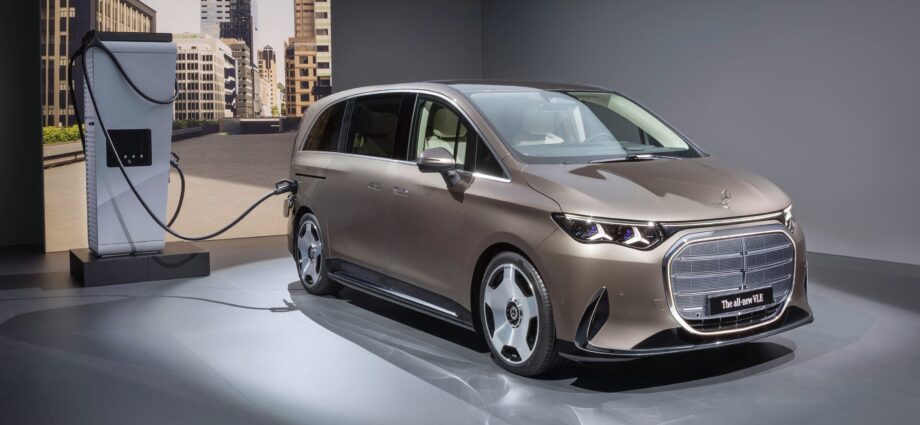
Mercedes-Benz is hoping that its all-new VLE-Class of vehicles will be the next white space hit in a category that’s familiar to Europe and Asia but almost entirely new to North America—the luxury multipassenger vehicle (MPV) segment.
It’s also no doubt hoping that everyone will refer to the VLE MPV as a “grand limousine.” There’s probably another description of it that springs to mind, however. If you’re looking at these European-market photos and saying, “Um, it’s a minivan,” we wouldn’t blame you. But consider the spec sheet. Globally, the VLE will come in two sizes, neither of them mini. At 209.0 inches long, the short-wheelbase VLE is about 5 inches longer than a Toyota Sienna minivan and 3 inches longer than Benz’s large GLS SUV.
North America will only get the long-wheelbase VLE, whose 215.9-inch length is over 3 inches longer than a Cadillac Escalade. The additional length is entirely added to the B-pillar, creating a gap between the front and rear doors. This creates space for the rear cinema while preserving passenger and cargo space—key priorities for the VLE, because the party, as they say, is definitely in back.
VLE = Electric + All-Wheel Drive
At launch (so far, timing is super vague other than to say it will arrive here sometime in 2027), the 2028 VLE will come with two electric powertrains. Both will utilize a 115-kWh (usable) nickel manganese cobalt (NMC) battery pack. For the VLE300, a single permanent magnet electric motor will drive the front wheels, while the VLE400 4Matic uses two motors for all-wheel drive, with a clutch disconnecting the rear when it’s not needed.
The VLE300 is rated at a claimed 272 total system horsepower, with the VLE400 rated at 409 hp. Mercedes says the all-wheel-drive VLE400 will hit 62 mph from a standstill in 6.5 seconds. And if transporting a pop star with band equipment to tow, front-drive models can pull 3,300 pounds; all-wheel-drivers 5,500.
The maximum range is estimated at 404 miles on the generous European WLTP fuel economy cycle, aided by a claimed drag coefficient of 0.25. Our estimate of what the U.S. EPA will find is around 360 miles or so of range to a full charge. With an electrical system rated for 800V, the VLE should also be quick to charge; Mercedes-Benz claims it can add close to 200 miles of range in 15 minutes on the fastest DC chargers.
After launch, a more affordable version of the VLE is planned for North America, featuring an 80-kWh (usable) lithium iron phosphate (LFP) battery pack. While it’s not clear what that model will be named, the U.S. will not be getting the entry-level VLE250, which is the base model that will be sold in more established MPV markets.
Later still, Mercedes-Benz will launch non-EV powertrains for the VLE, presumably gas, diesel, and hybrids, following current V-Class models, which the VLE is replacing globally. America should receive gas and possibly hybrid powertrain variants after the EVs arrive. Details are still being sorted, but North America is expected to have the greatest appetite for these models.
