 Skip to content
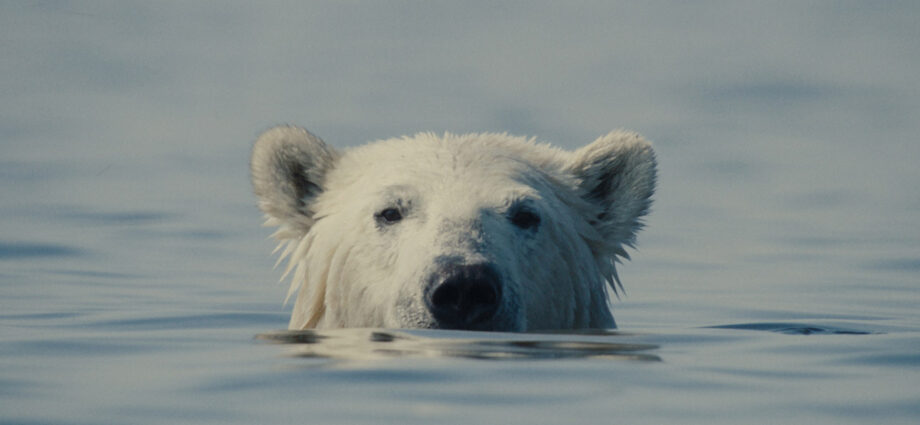
There’s no shortage of captivating nature docs in which advanced 21st century audiovisual technology allows for breathtakingly close images of magnificent creatures in the wild. But when nonfiction films go beyond the scope of observing animals in their threatened natural habitats to examine humanity’s troubled relationship with them, the results can be uniquely affecting. Werner Herzog’s recent Ghost Elephants is a good example, rendered poetic by its marriage of conservation biology with inquiring philosophical contemplation.
Sundance Grand Jury Prize winner Nuisance Bear does something similar by looking at the compromised conditions for polar bears in the Canadian Arctic alongside the heavy costs of Western commercial settlement to the Inuit people who have co-existed with the majestic predators for 4,000 years.
Nuisance Bear
The Bottom Line
Watch and bear witness.
Venue: Sundance Film Festival (U.S. Documentary Competition)
Narrator: Mike Tunalaaq Gibbons
Directors: Jack Weisman, Gabriela Osio Vanden
1 hour 29 minutes
Expanding their wordless 2021 short of the same name to compact feature length, co-directors Jack Weisman and Gabriela Osio Vanden have made a doc of lingering beauty, sadness, insight and even unexpected humor. While the short film’s absence of dialogue made it unusually direct and immersive, the longer version retains that bear’s-eye-view immediacy alongside first-hand access to Indigenous beliefs, deepening our knowledge across the human-animal spectrum while remaining more subtly interpretive than informational.
Part of that is the effective choice of confining English-language input to what we overhear from wildlife and conservation officers, guides and tourists. The closest thing to a talking head is the Inuktitut narration threaded throughout from Mike Tunalaaq Gibbons, a community elder from the town of Arviat on the western shore of Hudson Bay, who passed away last year in his early 80s.
At the risk of sounding patronizing about infrequently heard Indigenous languages, Tunalaaq’s mellifluous rumble and soft-spoken reflections on tradition, change and devastating personal loss give the doc a distinctively soulful voice. He speaks of interconnectedness, of there being no separation between ourselves and nature, of the ancient understanding that bears and humans are equal, both species powerful and dangerous.
This spiritual side is amplified by the brilliant Cristóbal Tapia de Veer’s astonishing score. As he did on the first three seasons of The White Lotus, the composer folds together vigorous percussive fantasias with evocative cultural accents to reflect the setting and mood, the music contributing greatly to the movie’s sensory impact.
Tunalaaq recounts a story that is painful to tell, and while it’s light on details, it nonetheless prompts a sharp intake of breath. But it’s one of many instances in his thoughtful narration that points up cultural differences, ways of seeing that alter our perspective — whether on the benefits of conservation or the categorically negative impact of hunting.
Even the film’s title opens itself up to questioning. Is it the polar bears — their annual northbound journey slowed by climate change, which causes delays to the formation of their icy hunting platforms — who are the nuisance when they come sniffing around human settlements for food? Or is the nuisance the settlers, colonial traders who built the town of Churchill, Manitoba — “Polar Bear Capital of the World” — directly on the bears’ ancient migratory path?
Weisman and Osio Vanden’s short film was shot in Churchill, and the small subarctic town rewards further exploration. While polar bears were routinely shot when the Fort Churchill U.S.-Canadian military base was operating, from 1942 to 1980, they are now protected by law. But when bears are traumatized by the ordeal of being trapped, caged, tagged for identification, monitored and transported long distances before being released, you start to wonder how much downside comes with the good of animal protection programs.
An extended version of a nail-biting sequence shown in the short, which is both spectacular and distressing, follows the relocation of a “nuisance bear,” drugged up and bundled in a rope net dangled from a helicopter for the duration of the disorienting journey north. The part that’s hardest to watch is what immediately follows, with the still-tranquilized bear splayed out on the ground, powerless as wildlife officials bolt a radio transmitter to its ear and paint a large green spot on its upper back for aerial identification.
Tunalaaq speculates on the psychological damage this inflicts on a polar bear. “The bear is a visitor from the past navigating a maze of the present,” he says, pointing out that the world in which bears and humans kept a safe distance from each other no longer exists.
The longer bears spend in environments with humans, the more they lose their fear. Tunalaaq maintains that exposure to human noise — clanking industrial sounds, trucks, tour vehicles and the bikes, jeeps, choppers and pest-control cracker-shot rifles used to shoo bears away from towns — is causing the animals to lose their hearing. The number of adult bears trapped and prematurely separated from their cubs leads to unpredictable behavior patterns in the young.
The ecotourism invasion yields images that are almost surreal, with huge “tundra buggies”— outsize, boxy buses on massive all-terrain wheels, with viewing platforms built on the back — rolling across the horizon in fleets. The confused looks on the bears’ faces as they plod on among tour vehicles disgorging photographers requires only that image, no words, to be saddening.
The unfair advantage of humans in this equation yields a hilarious moment of triumph when an ursine hero warily approaches a large cylindrical trap with a bait hanging at the far end. The bear puts a paw inside to test the structure and then hesitates, stepping around to inspect the sides and back of the contraption before making a quick dash in to grab the meat and getting out just as the trapdoor is coming down. Bravo!
Weisman and Osio Vanden, who head a team of six cinematographers, open with the obligatory cuteness overload of polar bear cubs nestled into their sleeping mother’s flanks for warmth or gamboling along behind her. There’s also beautiful footage of foxes, of stonking big crows right out of Poe and caribou with sprawling antlers that are like contemporary art sculptures.
But those enrapturing images are deceptive; Nuisance Bear is not that kind of straightforward, awestruck nature doc. The sight of bears ambling across the landscape or poking around garbage dumps for food grows more melancholy the more we know about their violated environment.
While Western conservationists for decades have sounded the alarm about a species edging toward extinction, the Inuits dispute this, maintaining that population numbers are up, based on the influx each year of bears from Churchill to Arviat, around 200 miles north. Hunting polar bears for food and income from the sale of hides is an Inuit cultural tradition. The practice is now strictly regulated by the Federal government, with names drawn by lottery to participate in the brief windows when restrictions are lifted.
Before regulation was introduced, the Inuits adjusted their hunt numbers up or down, depending on population estimates for the previous season. Nobody watching this film is going to love the idea of animals being harvested, but Nuisance Bear makes a convincing argument for population control.
Many of the points touched on in the doc, particularly those that pit Western thinking against Indigenous belief, stubbornly refuse to fit neatly into black or white answers. The most poignant points outline the losses to Inuit culture and the breakdown of traditional family networks caused by Western influences. Nothing says cultural contamination like an Indigenous kid dressed as Darth Vader for Halloween.
Tunalaaq says that for generations now, the semi-nomadic Inuits have been told that their knowledge is unscientific and worthless, and that their lives would be easier if they stayed in one place and followed white authority rules. He says that resulted in shame, and a reluctance to share stories, breaking the connection between elders and their heirs. Tunalaaq ruefully reflects that had he not refrained from sharing knowledge with his son, a family tragedy might have been averted.
The affinity between polar bears and Inuits — who long ago believed bears could turn into humans and back again — emerges organically without being pushed. The filmmakers seem to suggest that they share a similar sense of freedoms removed, of mournfulness for a simpler past.
Some might roll their eyes at the anthropomorphic aspect of “reading” a polar bear’s thoughts. But a shot of a bear sitting on a clifftop gazing out over Hudson Bay while waiting for the waters to freeze — flashes of seals, beluga whales and other prey shuffling through its head along with images of traps, cages and vehicles in pursuit — is one of the more heartrending movie images in recent memory.
Admittedly, I’m a sentimental softie for anything depicting mopey animals, but the sight of a weary polar bear lumbering across the tundra with a faded patch of green dye on its back seems like the saddest visual in the world.
