 Skip to content
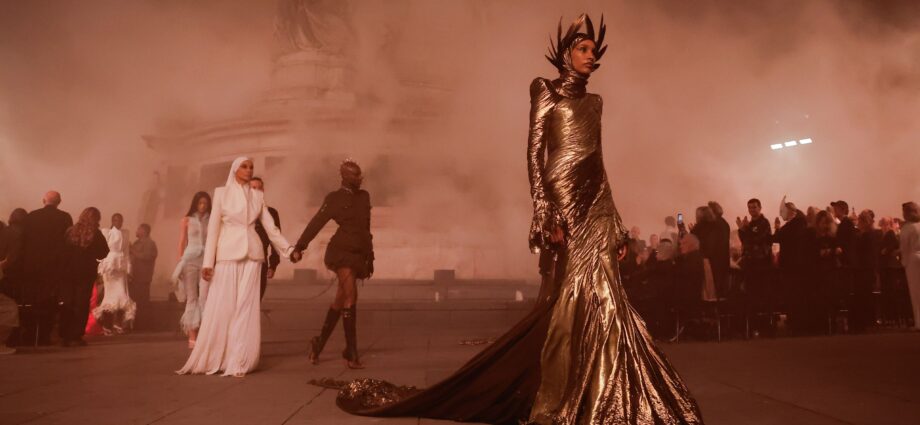
Paris is a city for grown ups. Paris Fashion Week, even more so. The shows deemed the best are often those by the headliners: Dior, Chanel, Saint Laurent, et al. But this season that premise was turned on its head from the very first evening last Monday.
The name on everyone’s lips at PFW has not been Anthony Vaccarello, bar his presumed departure from Saint Laurent, nor Chemena Kamali, despite the rumors about her future at Chloé, but that of Matières Fécales, a new-ish brand by Steven Raj Bhaskaran and Hannah Rose Dalton who went from club kids in Montreal to Instagram influencers and proteges of Rick Owens, to the designers behind some of the most celebrated red carpet looks of the year, namely Zendaya’s for the New York premiere of The Odyssey in July.
Their very viral show at Place de la République, a square in Paris famous for being a hotbed for protests, featured an appearance from Rihanna and flamed the fire of online discourse with its political messaging, which largely revolved around the way the 99% carries the rich, the remaining 1%, on their backs.

Rihanna at the Matières Fécales show.
WWD/Getty Images
At every fashion show, cocktail event, and dinner party, the Matières Fécales show was the topic du jour. What became evident as the week progressed was that the stars this Paris Fashion Week were not the usual suspects, but those often relegated to the fringes.
Whether the Matières Fécales collection was good enough to elicit such a response, or if the clothes were besides the point given the show’s poignancy, kept people talking. The messaging relied on some beautiful couture-like dresses that owed a large debt to Alexander McQueen, some others with the word “resistance” emblazoned across the chest, and the questionable image of a Black model carrying a realistic puppet of an aged white man whose eyes were covered by a dollar-bill mask. It was all muddled by the spectacle of closing off a public square to talk about resistance, of challenging wealth disparities as a billionaire (Rihanna) sat front row, with dresses only the very rich would be able to afford. The show was paradoxical at best, but its contradictions left a mark. It packed a punch with the kind of boldne`ss and urgency that fashion has abandoned in favor of a certain appeal-to-everyone blandness.
The show puzzled much of the old guard, but charmed the group of eccentric fashion fanatics who felt seen by the idea of the marginalized taking on the spotlight. The one thing everyone seemed to agree on is that there was a certain realness about the whole thing. Shows, the biggest and most popular ones this week, felt safe and sanitized. More concerned, perhaps fairly so, with establishing a commercial proposition rather than provoking conversation. “What I can say is that it’s all very earnest and honest and clear and true,” says the artist Miles Greenberg, who walked the Matières Fécales show and who met Dalton and Bhaskaran back in Montreal in the club scene. “There is no artifice, it comes from their hearts and from our lives.”
At Vaquera, Bryn Taubensee and Patric Dicaprio closed their show by performing their own rendition of Sonny and Cher’s “I Got You Babe.” It was the cherry on top of a show that was, largely, a return to form by two American designers who’ve grown up in front of the industry, starting off as baby-faced disruptors and developing their business, very publicly. Vaquera never became the next big thing, and that’s a good thing. It has remained punk.

Bryn Taubensee and Patric Dicaprio performing at the end of their latest show for Vaquera
A few days before the show, Di Caprio and Taubensee joked about how their last collection, which they developed in New York before relocating to Paris last year, was their own version of selling out. They tried to go commercial and debuted a monogrammed logo they haven’t reused since, plus a line of basics—tees, tank tops, etc.—shown together with their usual eccentricities. In March, their first show since moving here, they returned to their early antics, those outlandish shapes and rebellious energy about what fashion should look like. It was as niche as Vaquera has always been, but it had the gloss of two grown ups who meant business. Di Caprio said that it was successful commercially, which inspired them to continue in that direction this season.
“Being creative is what makes these collections do well at retail,” he said, “so we decided to go back to the energy of the early days.” The show had extravagant gowns first shown in all white and then in bright neons, and their usual character work: a French maid’s uniform, some military garb, and a little tuxedo. An editor a generation ahead of Di Caprio and Taubensee called the collection “fun, but self-indulgent” in conversation.
Many of the shows this season have been solely the latter: collections that overextend themselves with endless repetition of shapes (and at times full looks) shown at large-scale venues where the clothes become specs of dust in the distance, playing second-fiddle to celebrities in the front row.
But Di Caprio and Taubensee’s self-indulgence is authentic—they know who they’re dressing. Niche and all, they are speaking to themselves, yes, but also to a tight group who is happy to watch them perform.
On Saturday, at the halfway point of PFW, the famed fashion editor Tonne Goodman posed an interesting question to a group of journalists: “What’s the most fun you’ve had all week?” She wanted to hear about a show that was engaging and amusing and delightful.
Benjamin Barron and Bror August Vestbø’s August Barron presentation fit the bill. The pair hosted theirs at La Cigale, the historic performance venue in Pigalle, Paris’s red-light district. It was tantalizing.

Models pose onstage at Le Cigale at the end of the August Barron show
Models walked onto elevated runways in stripper-high heels and, sometimes, Playboy Bunny-style ears. The crowd—friends, fans and a small number of reporters—hooted and hollered after each look as if the performance was not a fashion show, but a cabaret. Underneath the spectacle lies a collection of compelling fashion propositions, a great slip blouse, a ruched mini dress, a fun baby tee. This is the kind of show, late at night and by a smaller label, that not everyone is able to prioritize. But those who did attend have been raving about it since.
“It is remarkable that in Paris, the grand finale of fashion month, some of the most buzzed about shows are smaller independent talents,” says Chloe King, the fashion director at Saks and Neiman Marcus. These designers are subversive and exuberant, she says, but they’re also authentic. It’s what has brought them “a hyper-engaged following that continues to draw the industry in.”
There may be no better example than Rick Owens, a designer who has made freakdom his coat of arms, and who has managed to stay at the fringes, at least aesthetically, despite his brand becoming beloved by celebrities like Kim Kardashian.
Broadly, this was a season that was preoccupied with elegance as a commercial proposition. Designers spoke of cocktail hour and of “real people” and their desire to dress up. And yet some of the best skirts and most shoppable dresses came from Owens, whose show also included some sci-fi worthy looks, and from the band of weirdos who rarely make the guest list at those prime and proper occasions.
In many ways, these shows and the attention they drew are the antithesis of the spectacles and gimmicks implored by some of the major brands. The scale and ambition of a show is no longer enough. In the age of AI, of replicas, what seems to move is emotion and grit. It’s why the freaks have taken over Paris. There’s more interesting things happening off center.
-
From Prince George to Princess Leonor: Where Young Royals Will Attend School This Fall
-
The Pitt’s Patrick Ball on Shipping, Stardom, and Season 3
-
From Cowboys to Clean Girls: The State of American Style, in Pictures
