 Skip to content
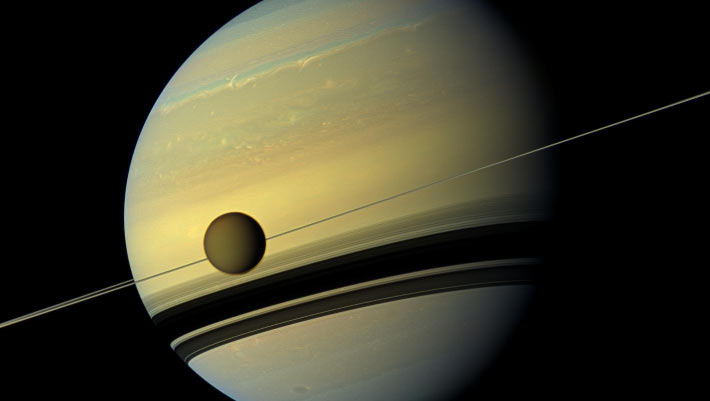
In a paper to be published in the Planetary Science Journal, scientists from SETI Institute, Southwest Research Institute, Caltech and the Observatoire de Paris argue that two Saturnian moons, Titan and Hyperion, are not primordial worlds, but the result of a dramatic merger between two ancient moons. The findings could rewrite theories about how Titan’s thick atmosphere emerged and may even help explain the origins of Saturn’s iconic ring system.
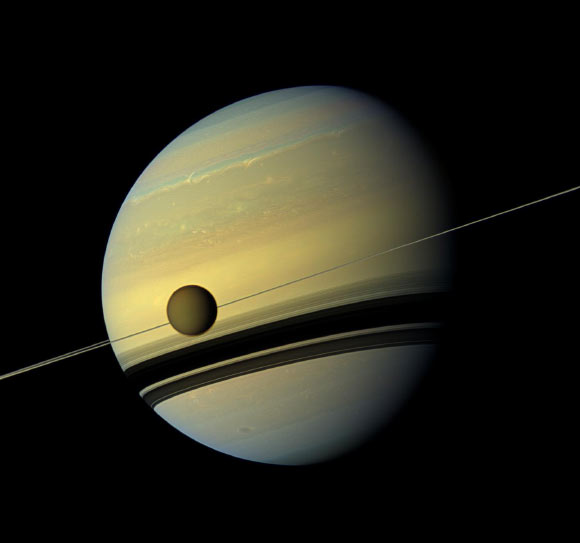
This mosaic of Saturn and its largest moon Titan combines six images — two each of red, green and blue spectral filters — to create this natural color view. The images were obtained with Cassini’s wide-angle camera on May 6, 2012, at a distance of approximately 778,000 km (483,000 miles) from Titan. Image credit: NASA / JPL-Caltech / Space Science Institute.
In their paper, SETI Institute scientist Matija Ćuk and colleagues present a new model for the recent dynamical evolution of the Saturnian satellite system.
“It is motivated by the apparent youth of Saturn’s rings, apparent dynamical youth of the inner mid-sized moons, the observed fast tidal migration of Titan, fast damping of Titan’s inclination and eccentricity, and the fact that Saturn seems to have exited recently its assumed past spin-orbit resonance with the planets,” they said.
The authors argue that Hyperion — a small, irregular moon locked in a 4:3 orbital resonance with Titan — is far younger than long assumed.
Its present-day elongated orbit implies that Titan has migrated outward by about 4-5% since the two bodies became trapped in resonance.
This resonance, according to the team, likely formed only 400 to 500 million years ago.
To explain Hyperion’s apparent youth, the researchers propose a scenario in which an additional mid-sized moon, dubbed proto-Hyperion, once orbited between Titan and Iapetus.
As Titan’s orbit expanded, the system destabilized; proto-Hyperion was driven onto a chaotic path and ultimately collided with Titan.
The merger would have broken a long-standing spin-orbit resonance between Saturn and the planets, altering the ringed planet’s obliquity.
At the same time, debris from the impact could have accreted into the present-day Hyperion, whose low density and high porosity suggest a rubble-pile structure rather than a primordial, intact body.
Numerical simulations conducted by the team show that collisions between Titan and the hypothetical moon occur frequently under such conditions.
In many runs, Iapetus acquired orbital inclinations and eccentricities similar to those observed today, consistent with gravitational perturbations during the instability.
The simulations also indicate that Titan’s orbit would typically jump outward during the merger, allowing its ongoing tidal migration — potentially driven by resonant interactions within Saturn — to resume.
The instability may not have been confined to the outer Saturnian system.
The scientists argue that an eccentric Titan, excited during the event, could have destabilized Saturn’s inner moons through resonant interactions.
Collisions and re-accretion among those moons may have generated material that formed the present ring system.
Independent lines of evidence have previously pointed to a relatively young age for Saturn’s rings — perhaps a few hundred million years — based on their mass, composition and interactions with nearby moons.
The new model links that timing to the same episode that produced Hyperion and reshaped the outer system.
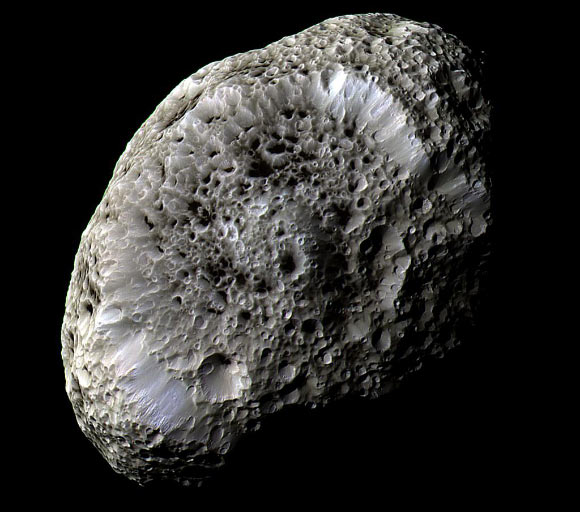
Cassini passed Hyperion on 31 May 2015 at a distance of about 21,000 miles (34,000 km). Mission scientists expect images from the encounter to arrive on Earth within 1-2 days. This view of the moon was obtained during Cassini’s flyby on 26 September 2005. It reveals crisp details across the strange, tumbling moon’s surface. Differences in color could represent differences in the composition of surface materials. Image credit: NASA / JPL-Caltech / Space Science Institute.
“Hyperion, the smallest among Saturn’s major moons provided us the most important clue about the history of the system,” Dr. Ćuk said.
“In simulations where the extra moon became unstable, Hyperion was often lost and survived only in rare cases.”
“We recognized that the Titan-Hyperion lock is relatively young, only a few hundred million years old.”
“This dates to about the same period when the extra moon disappeared.”
“Perhaps Hyperion did not survive this upheaval but resulted from it.”
“If the extra moon merged with Titan, it would likely produce fragments near Titan’s orbit. That is exactly where Hyperion would have formed.”
The authors also reexamine the history of Rhea, whose rapid outward migration implies it would have crossed the so-called evection resonance with the Sun in the past few hundred million years.
Such dynamical markers are more consistent with a system that has undergone recent, large-scale rearrangement than with one that has remained unchanged for billions of years.
“While the events described here took place hundreds of millions of years ago and are difficult to confirm directly, recent observations have consistently challenged previous models and revealed new dynamical pathways,” the researchers concluded.
“Our hypothesis predicts a dynamically active and relatively young Saturnian system whose present configuration is the product of recent, dramatic events.”
“Future orbital, geophysical, and geological data, particularly from missions targeting Saturn’s moons, will provide essential tests of this scenario.”
_____
Matija Ćuk et al. 2026. Origin of Hyperion and Saturn’s Rings in a Two-Stage Saturnian System Instability. Planetary Science Journal, in press; arXiv: 2602.09281
