 Skip to content
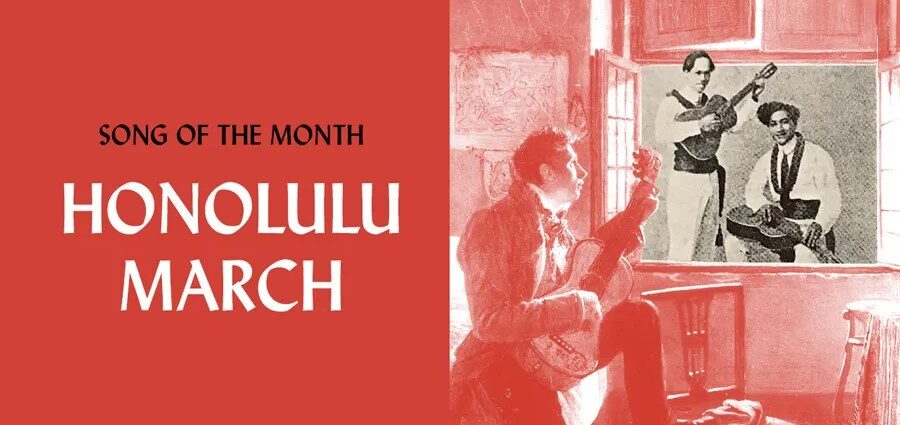

“Honolulu March,” recorded by guitarists Pale K. Lua and David K. Kaili around 1914–15, reflects the early steel-guitar style that captivated mainland audiences during the first Hawaiian-music craze. Lua was one of the early lap-steel players to record commercially and tour the mainland with Hawaiian troupes at a time when the instrument’s sliding, vocal-like sound was still new to most American listeners. Be sure to click here and listen to the original recording before you dive into the notation. On the original recording, Lua plays the steel-guitar melody, while Kaili provides the rhythmic accompaniment on standard guitar, a pairing typical of early Hawaiian guitar duets recorded during this period.
The tune unfolds in four main sections. The first two, A and B, are 16-bar strains in A major, each heard twice. The C section shifts to D major and expands to 32 bars before repeating. Continuing in that key, the D section returns to a 16-bar strain that closes the piece.
This arrangement, which is inspired by the original recording, is for two guitars: one plays lead, with a slide, while the accompanying guitar part keeps the rhythm.
Song of the Month is available to Patreon members at the Supporters ($5) tier. Once a month Acoustic Guitar Editor Adam Perlmutter delivers an expertly transcribed song to add to your repertoire. Some highlights include “Hotel California,” “It Ain’t Me Babe,” and a chord-melody arrangement of “Avalon.” And as the name indicates, we share a new song every month!
Lead Guitar: The slide melody is played in open-A tuning (lowest note to highest: E A E A C# E). To get there from standard tuning, raise your fourth string from D to E, third from G to A, and second from B to C#.
Shape the phrases as if you were singing them, using smooth slides and a controlled vibrato. Keep a lively march feel, but let the melody move freely between notes in the characteristic Hawaiian style. Throughout the tune you’ll notice open E notes punctuating the melodic line. These are played by briefly lifting the slide before returning to position. At tempo, that motion can feel awkward. Work on those passages slowly at first, focusing on small, economical movements of the bar while keeping the picking hand steady. Once the motion becomes automatic, the phrases will sit much more comfortably in time.
Rhythm Guitar: The accompaniment guitar part, modeled on Kaili’s role in the original recording, is shown here in chord frames and is played in standard tuning. The part uses simple open-position shapes but provides the rhythmic backbone of the arrangement. The pattern is essentially a boom-chuck feel, with bass notes on beats 1 and 3 and chord strums on 2 and 4, giving the music its sturdy march pulse while leaving room for the steel melody above.
Early Hawaiian guitar recordings like this one rely on a clear division of roles: a lyrical slide melody supported by a steady rhythmic guitar. Keeping those two parts balanced—one singing, the other driving the beat—goes a long way toward capturing the character of the original performance.
The TAB and notation for “Honolulu March” are available to members of the Acoustic Guitar Patreon page at the Supporters tier or higher. Supporters also get exclusive access to the Acoustic Guitar Teaching Artists, which features a new video lesson every Wednesday.
