 Skip to content
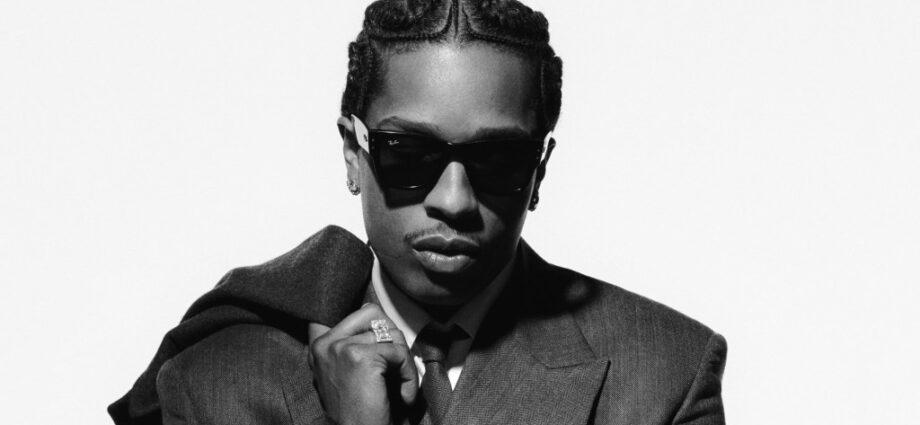
I’m geeking out because Jadakiss is standing behind me, wearing the navy-blue Supreme x Margiela zip-up, asking someone, “Where the bud at?” Across the sprawling Brooklyn performance space called the Compound Art & Sound Gallery, Jazzy Jeff blends Herbie Hancock’s “Watermelon Man” into Al Green’s “I’m Glad You’re Mine,” the same soul loop famously sampled on Biggie’s “I Got a Story to Tell.” The night is technically a celebration of Philadelphia. Black Thought is even performing later. Right now, though, he’s backstage with Kiss and the evening’s surprise guest: A$AP Rocky.
It’s a few hours after a sit-down with VIBE in Red Hook, where a pensive Rocky had a chance to talk through fatherhood, Harlem, taste, and what makes a home. Still fresh off the Met Gala earlier that week, Rocky is outfitted in a pink Chanel button-up and black trousers, chains from his brand, PAVĒ NITĒO, hanging from his neck. He rolled through to support the owner of the space, culture curator Set Free, whom he’s known since he was 21. Inside, every few steps we take get interrupted by someone he hasn’t seen in years, saying, “What’s up?” “Remember Comme des Fuckdown?” Rocky asks me. I nod. “That’s him,” he says, pointing out the brand’s founder, Ruslan Karablin, before dapping him up.
The venue is skeletal: Deep-brown wood beams form clean lines across the roughly 30-foot ceiling. Aesthetically, the place is a cross between a Williamsburg beer garden and a Bed-Stuy jazz club, which could neatly describe the reason for Rocky’s breakthrough success. He’s able to communicate ideas across the spectrum between different worlds. The room could easily double as a time capsule for the past quarter-century of rap cool. Ruff Ryders guys roll spliffs in the green room while blog-era streetwear figures mingle with New York rap veterans, all as Jazzy Jeff soundtracks the night from the DJ booth. The confluence mirrors Rocky’s own decade-plus career.
Rocky was born Rakim Mayers in Harlem, the son of a Barbadian father and a mother with African American roots. His early life was marked by instability: His father went to prison when Rocky was young, his older brother, Ricky, who taught him how to rap, was killed when Rocky was a teenager, and he spent part of his youth moving through shelters with his mother and sister. By the time he emerged with A$AP Mob, first through “Purple Swag,” “Peso,” and the 2011 mixtape Live.Love.A$AP, he already sounded like a full-fledged superstar. If the first act of his career was turning that turbulence into a global language of taste, the current one is stranger and wider: father of three, fashion power player, furniture obsessive, and, lately, an actor convincing enough to stand opposite Denzel Washington in Spike Lee’s Highest 2 Lowest.

Photography by JAMIL GS
What Rocky understood early on was how porous culture was becoming. Before he and A$AP Mob arrived, hip-hop still moved in strictly defined lanes. Downtown fashion kids occupied one space. Rap fans occupied another. Backpack-rap traditionalists stayed in their own corner, too. His breakout mixtape sounded like Houston chopped-and-screwed filtered through Harlem swagger and MP3 crate-digging. The project’s producer credits include everyone from Hit-Boy to Skrillex and Clams Casino, who was then known for his moody, atmospheric production with avant-garde internet-rap sensation Lil B.
Every sound he fused together felt inhabited, Rocky carried himself with a particular kind of Harlem confidence while dressing like somebody obsessed with runway archives, skate videos, Tumblr, and Japanese fashion magazines. He understood the importance of a cohesive vision. From the music video direction to the graphic design and merchandising, it all meshed within the same universe.
Watch the video interview below
Today, almost every rap newcomer arrives with some kind of visual identity already baked in. Fashion partnerships, mood boards, and the requisite appearance on a niche viral TikTok series are all expected. “We solidified the spot,” Rocky tells me in Red Hook. “Now it’s just norm. It’s a standard. Ain’t it crazy that any artist from today’s age has to already have the full package? There has never been a tacky superstar since me. Since I came out, everybody know how to dress. Everybody’s into fashion. Everybody got the braids or they got the dreads that look like the braids, or they got the gold grills, or they got the Margielas and Rick Owens and Raf Simons. All those trends that we did 15 years ago.”
Being ahead of the times doesn’t come without its detractors. On his latest album, Don’t Be Dumb, he’s not afraid to take some bold left turns, like the alt-rock leaning “Punk Rocky,” that have been meme-ified online, especially after a recent Chanel after-party performance in Biarritz, where clips of him playing the track quickly became social-media fodder.
“That shit was fire, bro,” he says. If some listeners didn’t quite know what to do with it, that was part of the design. “They still sleep on it. I had to throw them off,” he says. “The whole album ain’t ‘Punk Rocky.’ The whole album ain’t ‘Helicopter.’ The whole album ain’t just one kind of sound. Just play it, sit down, enjoy it, and shut the fuck up.”
That instinct—the urge to throw people off before they can get too comfortable— didn’t come out of nowhere. It is impossible to separate Rocky’s rise from A$AP Yams, the Mob’s late architect and great internet-era rap obsessive. Yams used the web like a cookbook, combining divergent scenes and subcultures and emerging with something that felt authentically new.

When I mention that taste seemed central to the movement Yams helped build, Rocky nods in agreement. But those days feel like centuries ago at this point. He says it has been years since an official Yams Day, the annual tribute concert held in his friend’s memory. Rocky still wants to celebrate him, but mounting something that big in New York has become complicated. “It was just a lot,” he says. Yams’ birthday falls on Jan. 18, “usually one of the coldest days of the year,” Rocky adds, imagining fans queued outside in brutal weather. That tension says something about Rocky’s current position. The culture he and Yams helped bring together now exists everywhere, but the actual communal rituals that made it feel alive are harder to sustain.
Looking through scans from his first VIBE story from back in 2012, Rocky laughs at first, then immediately recoils. “I see a lot of niggas in this I don’t fuck with,” he observes. “We gotta burn this.”
The joke points to the growing distance between his past and present. The world Rocky helped shape did not come without drawbacks: falling-outs among members of A$AP Mob, rap beefs with former collaborators like Drake, and the constantly moving goal posts of the attention economy. (As for Drake’s apparent A$AP Rocky diss on Iceman, which was released after our interview, a rep for him did not respond to a request for comment.)

Now 37, Rocky seems mostly interested in what comes next. When we talk, he’s weeks away from kicking off his Don’t Be Dumb Tour in Chicago. It’ll be Rocky’s first time on the road since 2019. “To go on tour, sometimes you got to quit drinking. You got to quit smoking. You got to get on a routine, get your breath work right. There’s a lot of preparation that goes into it.”
The tour is also a chance for Don’t Be Dumb to live beyond the discourse around its release. Rocky talks about performing almost like a proof of life, a way to see the music reflected back by the people it was made for. “Imagine putting out a product, and then thousands and thousands of people [are] coming together to celebrate that product,” he says. “That’s the shit that I live for.”
Don’t Be Dumb moves through different sounds and moods with a delicate touch. One of Rocky’s strengths is knowing exactly how far an idea can stretch before it breaks. The artwork for the album was designed by Tim Burton, who has become a major inspiration for Rocky lately. He jokes that he’s currently on “Tim Burton, ghetto expressionism, German expressionism shit, dad swag, suits, tailored, pushing 40 swag.”

The dad swag is important. Rocky shares three children with Rihanna, his longtime partner and a global superstar bar none, though he speaks about their family life with an expected level of protectiveness. “Being emotionally present, emotionally available, receptive, still endearing, but not only that, loving,” he says when I ask what fatherhood looks like for him. “That’s easy. That’s me all day. That’s just me.”
I ask Rocky if, after his first child, he ever got used to the feeling of having a kid. “It was just so exciting because you just don’t know what to prepare for,” he continues. “You don’t know what’s to come, so the second and third time was really similar to the first experience. We were laughing while she was in labor, literally laughing and cracking jokes and shit.”
Even the way Rocky thinks about work has changed because of family life. He says he rarely records at home anymore because he doesn’t want his kids around smoking sessions. Instead, he uses hotels and temporary spaces whenever inspiration hits. “Any kind of space, like 500 square feet or more,” he says.
So, what’s the biggest difference between the Rocky from the 2010s and the version sitting across from me now?
“A little bit of evolution and time,” he says. “We judge people, or you just base people’s character off the decisions that they make, and I made a couple of good decisions to make sure that I didn’t end up in a bad predicament. Back then, I was solidifying my spot in this rap game. And more so than ever now, it’s like it’s a reemergence, revivals, all of that. It’s just ever-going.”
In Rocky’s case, maturing does not mean becoming less ambitious. If anything, he sounds more creatively restless now than he did a decade ago. “I don’t know what I’m going to be doing in 10 years,” he says. “Hopefully, knowing me, more than likely it’s still going to be music. I don’t know what that’s going to look like, what that’s going to sound like, what my vibe is going to be, but it’s not going to be what I’m on today.”

While his offspring will surely have it much easier than he did growing up, Rocky isn’t leaning into the privilege. “I want to make sure that I teach my boys discipline and keep them grounded, keep them humble as much as possible,” he says. “Because they could be considered nepo babies. I got to make sure they chill with their cousins, the rough cousins that’s going keep them on their toes.”
My first attempt to interview Rocky only lasts a few minutes. We’re barely into the conversation when the pull of the room takes him out of interview mode. “Hold on. Hold up, bro,” he says. “We got to go watch the stage, bro.” Black Thought is performing, backed by a live band, and Rocky doesn’t want to miss it.
During the set, Rocky is visibly locked in, catching pockets in the music and recording a quick flow into his phone before the moment disappears. He even had more in the tank tonight, but “Johnny Nuñez big head ass came and fucked it up,” he says, laughing about the person who interrupted his flow. Then he catches himself, still thinking about the band. “But it was a vibe,” he says. “That shit was a fucking vibe.”
Rocky has a reverence for the rap luminaries in attendance this evening. “All of those guys has been like big brothers or big homies to me,” he says. He met Kiss along with the rest of Ruff Ryders around 2011, right as his own career was beginning to accelerate. “I’m close to them because my cousin is a Ruff Ryder, so these niggas is my OG. I ain’t got songs with Kiss yet, but I got a song with Black Thought.” Then he starts naming names. “Black Thought, Mos Def. I think David Banner. Those are some of the most influential niggas on me because they personally big bro to me. Danger Mouse, big bro to me. Them niggas ain’t changed. They ain’t on nobody dick. They regular.”

Losing Virgil Abloh also changed the way Rocky thinks about work. The prolific designer, who made an indelible impact on the rap world, passed away in 2021 after a battle with cancer. During our conversation, he thinks back to the funeral, especially the moment when Virgil’s friends thanked his wife for “giving him to the world.” “It wasn’t easy, because it’s almost like that doctor analogy,” Rocky says about balancing the professional with the personal. “The doctor who’s a great doctor to all his patients is considered an absent parent. It’s about finding balance.
“I learned something really interesting at Virgil’s funeral, just hearing how his friends thanked his wife in the front row for being so selfless,” he continues. “Nobody knew he had kids till he died. That’s fucking crazy.”
Rocky still talks about creating things with a lot of excitement, but the old fantasy of endless output seems less romantic to him now. “Trying to balance sanity and still be inspired is really a tricky thing to do,” he says. “And it’s not easy. Sometimes you got to sacrifice time at home to be doing work-related things. Sometimes you just got to be fully present for that.”
“It’s a blessing to do this and to love what I do,” he adds. “Me being able to just be this eclectic creative dude to whatever capacity I feel is no-holds-barred, it’s a blessing.”
He believes being an artist should involve patience, experimentation, and actual taste. Visibility by itself doesn’t impress him very much. These days, he says, “the underground is so similar to mainstream. There’s really no separation.”

It explains why Rocky makes it a point to stay tapped in, and says he admires artists who feel impossible to duplicate. At one point, he brings up JPEGMAFIA and Earl Sweatshirt, two rappers with devoted cult followings who recently started a back-and-forth beef. Exactly the kind of underground-rap soap opera fans pretend to hate while feeding in real time. Rocky sounds less entertained than disappointed. “Both y’all fire,” he says. “Out of all the lames that’s dropping, y’all two want to beef with each other?”
Like the artists he admires, Rocky takes experimentation in his own music seriously. “If they don’t get it, fuck it,” he says about some of his newer material. “I’m making what I fuck with. I’m a chef. I’m cooking you these five-star dishes. If you don’t have this acquired taste, don’t listen to this shit. I’m not giving y’all McDonald’s and shit no more.”
One of the stranger things about Rocky’s career is that he disappears for years at a time. Albums take forever. He barely posts online compared with modern artists. “I’m 37, bro,” he says when I bring up how little he posts. “I got way other shit to do.”
Later on in the night, Rocky spots a man on the verge of being bounced from the room. His face changes slightly. “Damn, I think he’s on drugs or something,” he says quietly. “I grew up with him.” The man, Rocky explains, “used to be a skater.”
A security guard steps in and gently tries to offer Rocky a different read on it. “You grew up with him, but you learned the blessing,” he tells him. Rocky keeps coming back to their shared history: “But I grew up with him.” Then, almost as if the room refuses to stay heavy for too long, the guard starts talking about his own life: he’s 71, from the Bronx, 38 years sober, still working out every day. Rocky asks if he does pushups. The guard says he can do 80. “Bust out 80,” Rocky says, laughing now.

Rocky still sounds deeply tied to New York. He describes the city as a source of energy. “It doesn’t matter what borough,” he says. “You step out your building, it’s rocking. You don’t need a vehicle to just step outside and smoke your weed and think.”
Earlier this year, Rocky says, a violent intrusion at his Los Angeles home shook his sense of normalcy, briefly turning that everyday freedom he once took for granted into something that suddenly felt fragile. “It was fucked up,” he says quietly. “Somebody attempted at [harming] me and my family.”
“It took away a lot of peace and happiness of being able to just be free,” he says. “I don’t want to be robbed of my peace and joy.”
Protecting joy seems central to the version of Rocky in front of me. He stops to greet photographers, fans, old Harlem friends, random people drifting through the venue. “It’s nostalgia,” he says while describing plans for a giant Harlem cookout this summer. “Reminiscing about the old days.… Back then, you couldn’t stay at a cookout for more than an hour because motherfuckers start shooting,” he says. “But all of the shooters is older now. They parents now.”
Like many millennials, it says a lot about where Rocky and the people he came up with find themselves now. The kids who once represented chaos are now adults trying to carry pieces of that same energy into their lives. Rocky belongs to the first generation of internet rap stars, figuring out middle age while still remaining culturally central.
As our interview winds down, Rocky is still talking enthusiastically about the future. He’s preparing to go on tour, his first in seven years, and is headlining New York’s Gov Ball. His mind is still racing with ambition. He’s got furniture on the way and more film work. Years ago, A$AP Rocky helped teach rap stars how to look. Now, he’s trying to figure out how they should live as adults. That may end up being the most lasting thing he leaves behind.
