 Skip to content
Another key partner in the project is Jeff Qvale. His father, legendary California-based automotive entrepreneur Kjell, was instrumental in bringing British sports cars such as the MG TC and Austin Healey to America after World War II. Then, after BMC announced it was ending production of the Austin-Healey, he in 1970 bought the troubled Jensen factory near Birmingham at the behest of Donald Healey to create and produce the Jensen-Healey. “For me, this project is very personal because Jensen was such a significant part of my father’s life and our family history,” Jeff Qvale says. “What excites me about the Interceptor GTX is that it isn’t trying to recreate the past or compete with the most extreme modern hypercars. The car follows the traditional Jensen philosophy of a powerful, hand-built British GT with real character, but reinterpreted using modern engineering and technology.”
The Hardware
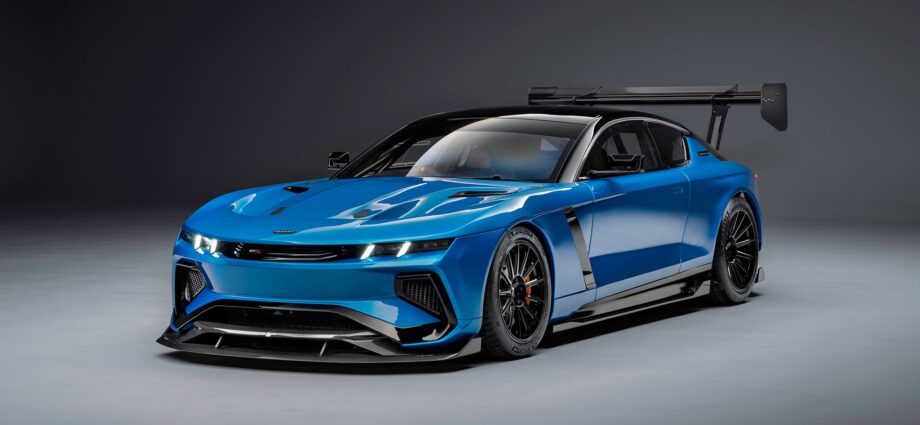
The new Jensen Interceptor GTX rolls on an all-aluminum chassis made up of bonded and riveted extrusions. It’s an interesting choice given Duerden’s background. An engineer, Duerden is a carbon-fiber pioneer, first working on the material for British Aerospace in the 1970s before moving into motorsports, where one of his earliest projects was to produce molded carbon-fiber chassis parts for German entrepreneur Willy Maurer’s successful Formula 2 and prototype Formula 1 cars in the early 1980s. But there’s a good, pragmatic reason for using aluminum rather than carbon-fiber for the Interceptor GTX’s chassis, Duerden says.
Whereas a molded carbon-fiber chassis would require expensive tooling that would also lock the car’s key dimensions, an aluminum chassis is less expensive to make and can be modified or altered easily. “When you start down the carbon road, you have to really commit to it,” he says.
Much of the hardware attached to the Interceptor GTX chassis is straight out of the race car handbook. The suspension is aluminum multi-link front and rear, with three-way adjustable coil-over shocks from British motorsports specialist Nitron handling the spring and damping chores. Steering is by way of a power-assisted hydraulic rack-and-pinion setup, and the braking system, developed by U.K. specialist BG Developments, features floating steel rotors and AP Racing calipers with competition-grade pads. Plus, there’s an adjustable ABS system like that used in race cars such as the Mercedes-AMG GT3.
The rear-mounted transaxle transmission is a six-speed sequential-shift dogbox from Lithuania’s Samsonas Motorsport; you change gears via a lever mounted on the transmission tunnel or paddles on the steering column. Drive is sent to the rear wheels via an American-made Wavetrac differential, which uses an innovative cam system to ensure maximum traction even if one wheel is in the air. The 20-inch wheels are forged items made by Miami-based Vossen Wheels.
The car’s aluminum body is handcrafted by Coventry Metalcraft, one of Britain’s leading specialist coachbuilding and prototype manufacturing companies. Though the process of hand-forming aluminum panels is complex, requiring specialist tools and skilled craftspeople, Duerden says for low volume cars it’s cheaper than making carbon-fiber bodywork. “All the body panel tooling is already produced and will last 10 or 15 units before it needs to be refurbished,” he says. That said, there are some carbon-fiber parts on the car, most notably all the race-face aero hardware at its lower extremities. Should the road-going GTR and GT models get built, most of that stuff—along with the humungous rear wing—will disappear.
The original Interceptor was powered by Chrysler V-8s, initially 6.3-liter and 7.2-liter big-blocks, the latter of which could be ordered with the fabled Six Pack triple Holley carb setup that boosted power to 385hp, before tougher emissions laws (roughly 50 percent of the 6000-plus Interceptors built between 1966 and 1976 were sold in the US) forced a switch to the milder 5.9-liter small block. The Interceptor GTX follows this storied British-American hybrid model (Allard’s J2 ran flathead Fords and Mercury engines in the 1950s and of course Carroll Shelby turned AC’s Ace roadster into the Cobra by stuffing a Ford small-block V-8 into it). But the V-8 under the GTX’s hood now wears a Bow-Tie rather than Mopar branding.
