 Skip to content
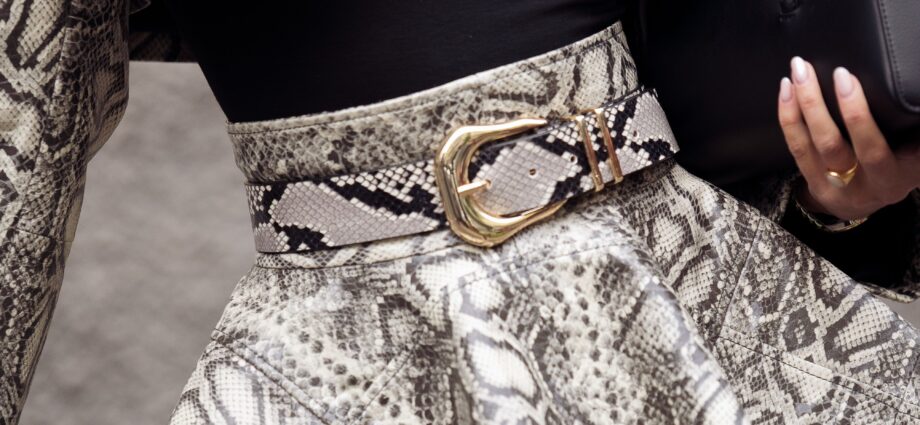
The power hip is a thing now. Yes, really. Fashion and its trends don’t just determine what will set the standard in terms of cut, color, or material in the coming months. Often we can also observe how certain body parts come to the forefront—only to reappear as focal points decades or even centuries later. The waist, for example, was cinched particularly tightly and emphasized in the 1940s and ’50s. In the Swinging Sixties, the miniskirt finally bared the legs. The ’80s were defined by broad, dominant shoulders.
In the 1990s, Tom Ford, during his tenure at Gucci, made the buttocks the center of attention with the help of a visibly flashing thong, while the Y2K trends of the ’00s targeted the midsection and declared crop tops socially acceptable. And most recently, the entire body took center stage with sheer “naked” dresses. Sometimes it was about sexual liberation, sometimes about reclaiming power, and sometimes about self-determination. This visual zoom-in on a specific area of the body was therefore never entirely arbitrary or random.
The return of hips on runways and red carpets
So what’s next? In a strikingly large number of fall-winter 2026–2027 presentations, the focus was on, of all things, the hips. Especially in Milan and Paris, hips were deliberately made the center of attention and staged in ways that were sometimes more dramatic, sometimes less so. Take Alaïa, for example, where strategically placed pleats at hip level on a yellow bustier dress automatically drew the eyes toward the body’s center. The design, with its basque waist, was unmistakably reminiscent of the dress silhouettes from the Rococo and Victorian eras—an aesthetic that is reaching its peak again this year.
A stylistically similar nod was also evident in Chanel’s runway collection, albeit with a slightly more understated touch, featuring curved, piped details along the hips. At Dior, opulent volume played a central role, which was particularly evident in the fashion house’s signature Bar Jackets, whose sweeping peplum cuts clearly accentuated the hip area. A play on proportions was also evident at Erdem, where the lines became significantly more voluminous toward the hips, resembling extremely exaggerated hourglass silhouettes.
For some fashion houses, the reference to fashion history was absolutely unmistakable, as was the case with Saint Laurent. For the current collection, creative director Anthony Vaccarello presented a floor-length black lace dress with a pannier skirt insert. A fusion of baroque and party-girl style that actress Zoë Kravitz apparently liked so much that she wore the dress to this year’s Met Gala.

Zoë Kravitz at the 2026 Met Gala
Getty Images

Rosalía Vila at the 2026 BRIT Awards
Gareth Cattermole/Getty Images
A call for the return of the hips was also particularly striking at Stella McCartney. In several looks, the hips protruded impressively outward, but the silhouette appeared more subtle and somewhat suitable for everyday wear in the label’s delicate camisole tops. At Junya Watanabe, the hips became a central element of the avant-garde looks, which were reminiscent of heavy armor. Duran Lantink, creative director at Jean Paul Gaultier, made them appear extreme in two different ways: sometimes broad and rounded outward, and other times dramatically draped, so that they almost resembled a stage curtain.
Speaking of the stage: Wide hips have made their way there as well. Rosalía, who is currently on a world tour promoting her album Lux, wears an outfit for part of her concert consisting of a satin bra, an oversized hat by the label Vivascarrión (inspired by the hairstyles of 16th-century women), and a custom-made, full-skirted hoop skirt. At the 2026 BRIT Awards in February, the singer performed in custom white Vivienne Westwood with exaggerated hips.
The historical influence
You might be (rightly) thinking, “We’ve seen all this before.” Like so many other trends, power hips are not new. It’s most reminiscent of the fashionable clothing during Marie Antoinette’s reign. This historical figure has reemerged as a source of style inspiration time and time again, from Sofia Coppola’s 2006 film about the royal to the resurgence of romanticism in fashion, literature, and film we’re seeing today. Great literary classics are back in demand, with films and series in the vein of Wuthering Heights bringing the exuberant aesthetics of the past back to the screen.

Charli xcx promoting Wuthering Heights.
Michael Buckner/Getty Images
The long-dominant trend of stark minimalism and quiet luxury is now increasingly giving way to sweeping opulence characterized by ruffles, flounces, lace, dramatically flared silhouettes, and—thanks to the use of corsets and crinolines—wide hips. This trend can be interpreted as a collective desire to dream ourselves back to a time that, while we did not experience it ourselves, somehow seems more fun-loving and free of prejudice, more hedonistic, than the one we currently find ourselves in. Escapism is one of the most frequently used (and most effective) creative tools at designers’ disposal.
Why power hips are more than just a fashion trend
But that’s not the only possible explanation: This development is interesting on several levels. Not least because the hips—or rather, a wide pelvis—are considered a symbol of femininity, fertility, and childbearing capacity, both from a cultural-historical and an evolutionary-biology perspective. These are social issues that have increasingly been debated, negotiated, and exploited by external forces in recent years.

Katy Perry at the 2026 World Cup kickoff
Kohjiro Kinno/Getty Images
The female body is, once again, a political issue being monitored, controlled, and dominated. This aligns with the theory from psychosomatic therapy that the hips, in particular, are the place in the human body where tension, stress, and trauma accumulate. The latest designs from fashion houses seem to be screaming in defiance of all this: “Hands off my hips!” The voluminous designs keep the outside world at a distance.
How to make the power hip more wearable
The exaggerated silhouettes we’re seeing on runways and red carpets aren’t exactly the most wearable in everyday life. That said, expect to see a change in silhouettes as you shop this fall. Peplum tops, hoop skirts, and other sculptural designs that accentuate the hips are already hitting stores and are easier to style than you may think.
Our suggestion? Neutral colors and safe basics will make the trend feel less intimidating. Try pairing a white peplum shirt with beige pants, like Taylor Swift wears above, or an all-black outfit. A favorite pair of jeans can also help ease in a new-to-you silhouette.
Aligne Daphne Waisted Blazer
Nordstrom Draped Cap-Sleeve Peplum Top
Chelsea28 Seamed-Waist Maxidress
Reformation Anelis Dress
What sets this new hip trend apart from the ’00s
Hips were already a hot topic of conversation about 26 years ago, in the fashion of the ’00s, when waistbands dropped so low that skin-tight jeans no longer sat on the hips but below them. The difference from back then, however, is clear: At that time, this look went hand in hand with an extremely slim beauty ideal that was considered a must in order to even be part of the trend.
In contrast, the hips today don’t care about clothing sizes. They are neither to be hidden nor concealed. While wide hips were considered a problem area not so long ago, designers are now erecting a sort of fashion monument to them—as a symbol of sensuality, strength, and self-determination. You could say, after the power shoulder comes the power hip.
A version of this story originally appeared in Vogue Germany.
