 Skip to content


Alones Creative/Getty Images
Rockets have been around longer than you probably think. The concept dates back to ancient Greece, though the first actual rockets were likely made in China around the 11th century. Just as these rockets were used as weapons, the basic concept of a long device that propels itself at high speeds using some sort of fuel is still used for missiles today, as well as fireworks and (of course) space travel.
Russian scientist Konstantin Tsiolkovsky is often credited as the father of modern astronautics for developing the theory of rocketry and even proposing their use for space travel in the early 20th century. In 1926, American Robert H. Goddard launched the first successful liquid-propelled rocket, turning rocketry from theoretical to practical. Not long after, the earliest movies about space travel began to emerge.
But while Tsiolkovsky and Goddard’s work helped establish modern rocket science and space travel, and filmography followed close behind, the idea of linking the two goes all the way back to a 1657 novel. Cyrano de Bergerac, who is best known today as the subject and namesake of an 1897 play, was actually the first to make the connection between rockets and their potential use in space exploration.
Cyrano de Bergerac predicted rockets could take humanity to space

Pvince73/Shutterstock
In his posthumously published 1657 novel, “Other World: Comical History of the States and Empires of the Moon” (often shortened to “A Voyage to the Moon”), Cyrano’s protagonist, also named Cyrano, is finally able to make it to the moon after soldiers attach fireworks to his flying machine. According to sci-fi author Arthur C. Clarke, that makes de Bergerac a pioneer of rocketry.
In Clarke’s 1952 book, “The Exploration of Space” — which convinced President John F. Kennedy that landing on the Moon was possible — he credited Cyrano as being the first to think of, or at least write about, rocket propulsion for moving humans through the heavens … space travel! Cyrano also predicted the ramjet, a type of engine that uses forward momentum to compress incoming air. This technology is still used today for military devices, including nuclear-powered missiles.
Cyrano got one major thing wrong about the rocket
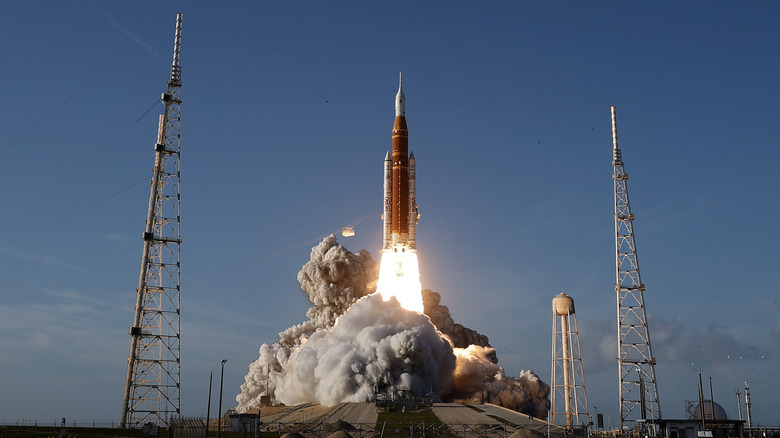
Chip Somodevilla/Getty Images
However, the 17th-century author did get one big thing wrong. Due to his lack of accurate knowledge about physics, an emerging science at the time, deBergerac believed that the engine would face upwards to lift the rocket rather than being propelled by fuel and pressure going down. Of course, this was back when people thought it was possible to land on the sun, so we can’t really fault a man who died in 1655 for not predicting every detail correctly. At the very least, he was trying to incorporate actual science into his space travel story rather than pure fantasy, unlike other authors of his time.
While we now know far more about space exploration and have accomplished things Cyrano could have only dreamed of in the centuries since he wrote “A Voyage to the Moon,” it’s worth reflecting on what people used to believe. As NASA’s Artemis II mission furthers humanity’s quest to explore the moon and beyond, it’s interesting to see how writers and thinkers like de Bergerac got an impressive amount right despite being limited by the times they lived in. It’s an inspiring reminder that, just because something seems impossible now, that doesn’t mean it will stay that way forever.
