 Skip to content
Whitebalance.space/Getty Images
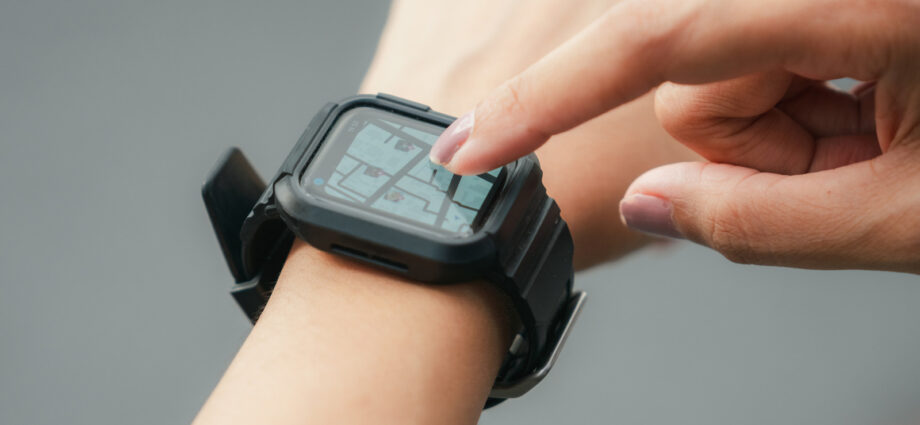
Some smartwatches only last a day before they need to be recharged. But there are many smartwatches that last for days, even weeks per charge. Some can last virtually an infinite amount of time, at least months, with constant exposure to sunlight or a strong light source via solar power. But with any smartwatch, even the ones that last longer than others with typical use, there’s one feature that drains battery life very quickly: built-in GPS. Using this feature will drastically impact battery life, as stated in the specs for any model that has it. The more you use it for a walk, run, cycle, hike, or even to navigate to a destination, the faster the battery will drain.
You can manage your expectations, of course, being mindful that if you go for a run every morning, you’ll likely have to recharge your smartwatch more often than the specs suggest. If you’re using it to navigate a trail while on a biking trip, you should note the same. Some models do better than others at conserving battery life, even when you use this feature.
How GPS works in a smartwatch
Maksim Safaniuk/Shutterstock
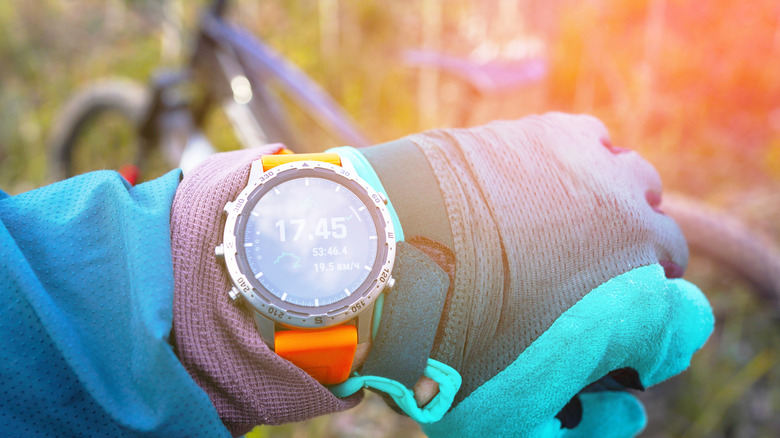
Smartwatches work with either built-in or connected/assisted GPS. With the latter, the watch uses your phone’s GPS, so you need to have your phone with you. This can also drain the phone’s battery more quickly, along with the watch. Smartwatches with built-in GPS handle this separately, which means you can leave your phone at home. They accomplish location tracking through tiny GPS receivers built into the wearable’s components, which pick up signals from the global positioning system (GPS), satellites orbiting the Earth. The more satellite bands that are supported, the more precise the position it can track. This is important for runners, hikers, and other outdoor enthusiasts who want to track their routes, especially when navigating unfamiliar terrain.
Built-in GPS allows tracking not only your route but also provides data on distance traveled and pace, valuable information if you’re training for a marathon or just want to log routes, have comparative data, and track performance and improvement. It’s also essential for safety reasons, so first responders and/or loved ones can find you if there’s an issue. But because built-in GPS relies on constant communication between the watch and satellites as you move, it drains a lot of battery life. This is even more so than other continuous tracking features like heart rate, because these typically only kick in every few minutes, whereas GPS is constant as long as you’re using it.
How GPS impacts battery life

zhukovvvlad/Shutterstock
GPS has a significant impact on your smartwatch’s battery life. If you have one rated to last up to three days per charge, for example, using GPS can cut this down to 12 hours. An advanced GPS running smartwatch like the Garmin Forerunner 970 lasts up to 15 days in smartwatch mode, but only up to 21 hours in the most advanced GPS mode, reduced to 12 hours if you listen to music, too. The Apple Watch Ultra 3 boasts the longest battery life of any Apple Watch, with up to 42 hours and 72 hours in Low Power Mode. But with GPS and heart rate, that drops to 14 hours. You can limit GPS and heart rate readings to conserve battery life, which can get it back up to 35 hours. Some smartwatch makers do better: the OnePlus Watch 3 lasts up to 16 days in Power Saver Mode, up to five days in Smart Mode. Even with heavy use, including moderate GPS use, it should still last up to three days.
The best way to avoid quick battery drain is to limit GPS use unless you really need it. If you’re tracking a walk on a familiar trail, disable GPS. Using power-saving mode means GPS tracking won’t be as frequent or as accurate, but it won’t drain the battery as quickly either. Consider a GPS watch that uses a hybrid GPS system, tracking only when the sensors detect it’s necessary.
