 Skip to content
Palace Pictures
The South African filmmaker Richard Stanley isn’t one of those directors you hear about often these days, though he does have some pretty interesting movies in his filmography. The most famous may be the epic failure, “The Island of Dr. Moreau,” which Val Kilmer led with an all-star cast, whose scandalous production has become a legendary and infamous piece of trivia among cinephiles. Stanley was the original director (and co-writer) of that sci-fi horror before he was abruptly fired due to the often-cited reason of “creative differences.”
He also made numerous documentaries, and after a six-year hiatus from the industry, he returned in 2019 to deliver one of the best H.P. Lovecraft adaptations with “Color Out of Space,” starring Nicolas Cage and Joely Richardson. Frankly, it’s a miracle he achieved all that, considering that he launched his career with a feature debut he got sued for right out of the gate back in 1990.
As Sue Short notes in the 1999 book “British Science Fiction Cinema,” Stanley’s first feature film, “Hardware,” was sued by British publisher Fleetway Comics for plagiarizing a comic strip in a story called “SHOK,” originally published in the 1981 annual edition of the comics magazine “2000 AD.” Although the financial details of the lawsuit weren’t disclosed to the public, Stanley and Co. were eventually forced to acknowledge Fleetway Comics and the writers of “SHOK” in the final credits of the film after the suit was settled.
Despite its initial legal troubles, Hardware went on to become a commercial success and a cult classic among sci-fi fans
Palace Pictures
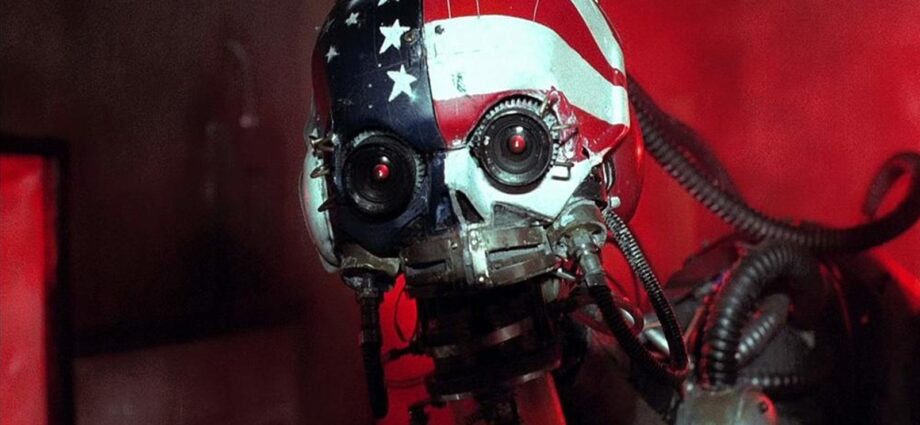
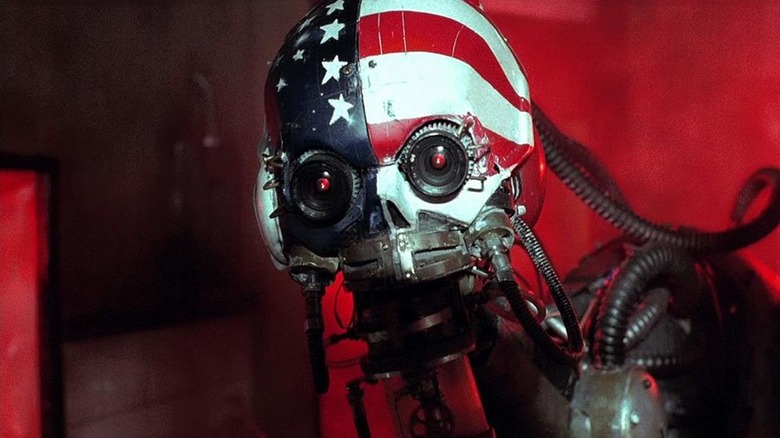
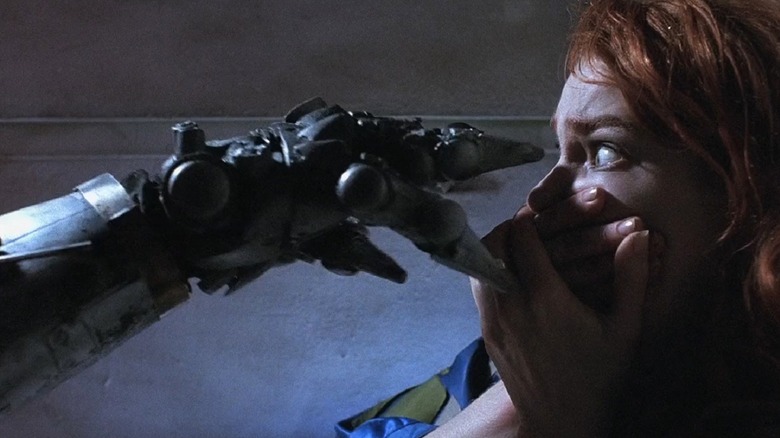
“Hardware” takes place in a post-apocalyptic future where radiation zone wastelands are littered with all kinds of scraps that scavengers collect and sell to junk dealers. Alvy (Mark Northover) is one of those dealers, and he buys the dilapidated body of a robot from his soldier friend ‘Hard Mo’ Baxter (Dylan McDermott), who holds onto the head to gift it to his sculptor girlfriend, Jill (Stacey Travis). What none of them knows, however, is that the android is a M.A.R.K. 13 model developed by the government to execute genocide as an answer to the world’s rampant overpopulation problem.
As it turns out, the robot possesses a self-repair mechanism, and Mo, Alvy, and Jill find that out the hard way once it attempts to kill them after reassembling itself with all the parts necessary to fully function. Despite critics dismissing it as nothing but another derivative low-budget exploitation flick upon release, “Hardware” managed to find some commercial success early on.
Made on a shoestring budget of $1.5 million, Stanley’s sci-fi horror grossed over $5.7 million worldwide at the box office, laying down the groundwork for its becoming a cult classic in the following years and decades. And while it’s hard to argue against the fact that “Hardware” was heavily influenced by such genre classics as “Robocop,” “Blade Runner,” and many other beloved sci-fi films — in addition to literally stealing from “SHOK” — it might become a hidden cyberpunk gem to those who haven’t discovered it just yet.
