 Skip to content
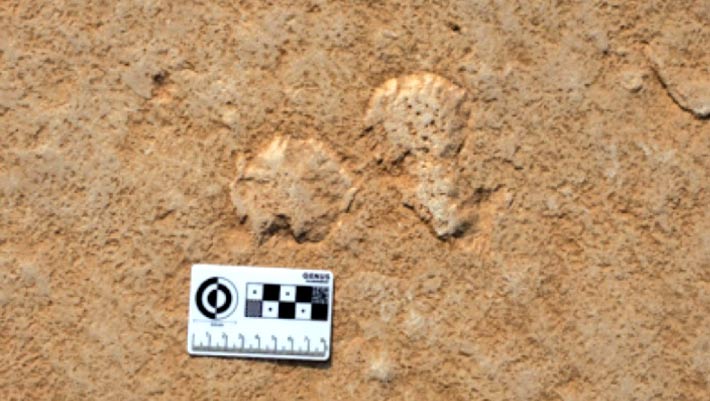
If you’ve ever wondered how geologists know so much about ancient beaches and shallow oceans — from the paleoenvironment to the animals roaming around, the seasonality of the weather, and even the time of day when the ancient scene was preserved — they owe it all to the sand particles bound together by microbes, forming structures known as microbial mats.
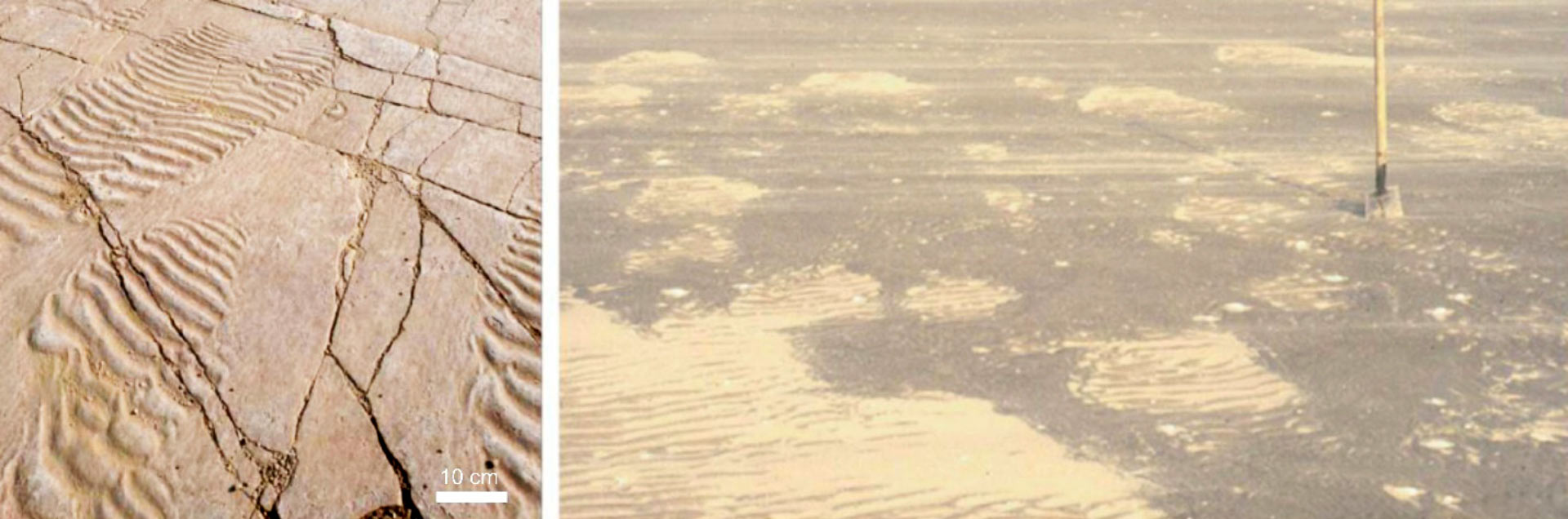
A planar microbial mat with scours of ripple marks on a Cambrian (left) and modern-day (right) tidal flat. Image credit: Nora Noffke.
Often dismissed as mere ‘pond scum,’ these slimy amalgamations of microorganisms and sand are the ‘secret ingredients’ largely responsible for preserving the sedimentological evidence of ancient worlds.
At the renowned Cambrian Blackberry Hill site in Wisconsin, USA, these microbial mats transformed the ancient tidal flats preserved in quartz sandstone into exceptional trace-fossil-factories.
By binding loose grains of sand together, these mats created a stabilized surface that could capture the delicate impressions of soft-bodied creatures like jellyfish (scyphozoans), the grazing behavior of ancient mollusks ‘bulldozing’ through the sand, the cryptic footprints of long-extinct arthropods, and other traces of animal movements.
Without this microbial glue, the shifting tides and storms of the Cambrian inland sea would have erased the trackways and trails as quickly as sand castles on a modern beach.
The discoveries at Blackberry Hill have provided some of the most significant insights into why animals were spending time on tidal flats approximately 500 million years ago.
The mats registered and preserved a trackway that helped determine what animal (a euthycarcinoid named Mosineia) produced some of the first trackways made on land (Protichnites), which had been a mystery for over 150 years.
They also helped scientists determine that arthropods, which are likely nimbler than the plump mollusks, could scurry higher on the upper intertidal areas in search of other food sources, possibly scavenging.
Large, slug-like mollusks the size of an adult human’s foot and rarely up to a meter long grazed on these microbial mats, producing trails called Climactichnites, suggesting the ‘scum’ was a primary food source that lured marine life into the intertidal zone (i.e., the transitional region between high and low tide along a coast).
By quickly overgrowing the traces, the microbial mats frequently helped prevent their obliteration by shielding them from tidal currents and storm surges. This process has provided a detailed record of animal activities, and even the ‘death traces’ (mortichnia) of animals that struggled to survive in a rapidly changing world.
Microbial mats preserved in the strata also served to inform of environmental conditions and events, such as seasonal changes and episodic storms. Ancient storm events are indicated by meter-scale pieces of torn and flipped thick microbial mats. Thick mats are too tough to register traces; only the thinner, more pliable mats can do the job.
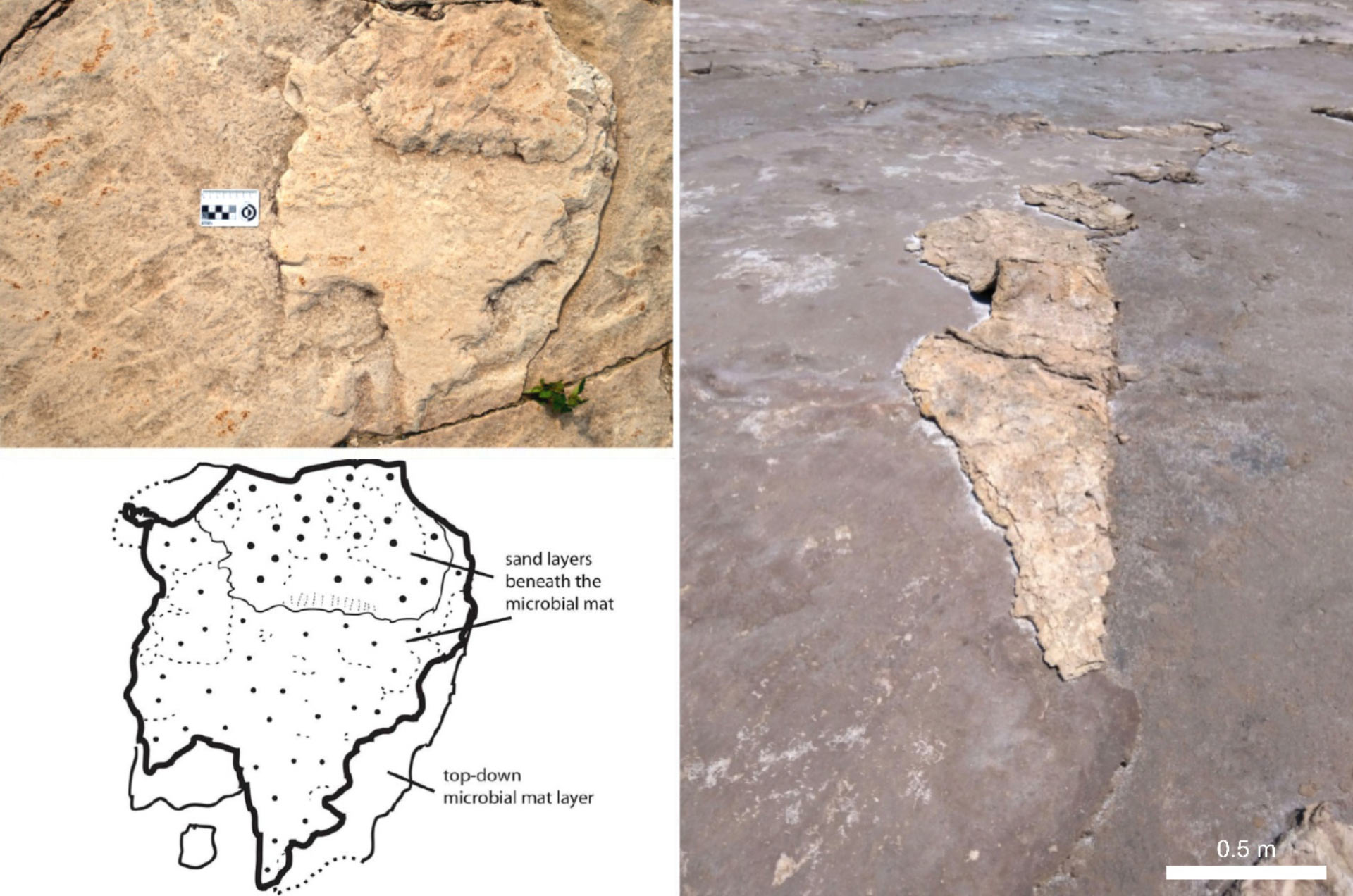
A large, flipped-over fragment of a microbial mat deposited on a Cambrian (left) and modern-day (right) beach. Note the trails Climactichnites near the scale in the left photograph. Image credit: Nora Noffke.
Additionally, mat chips broke off and were preserved, especially at the end of the growth season, when the microbial mats began to disintegrate.
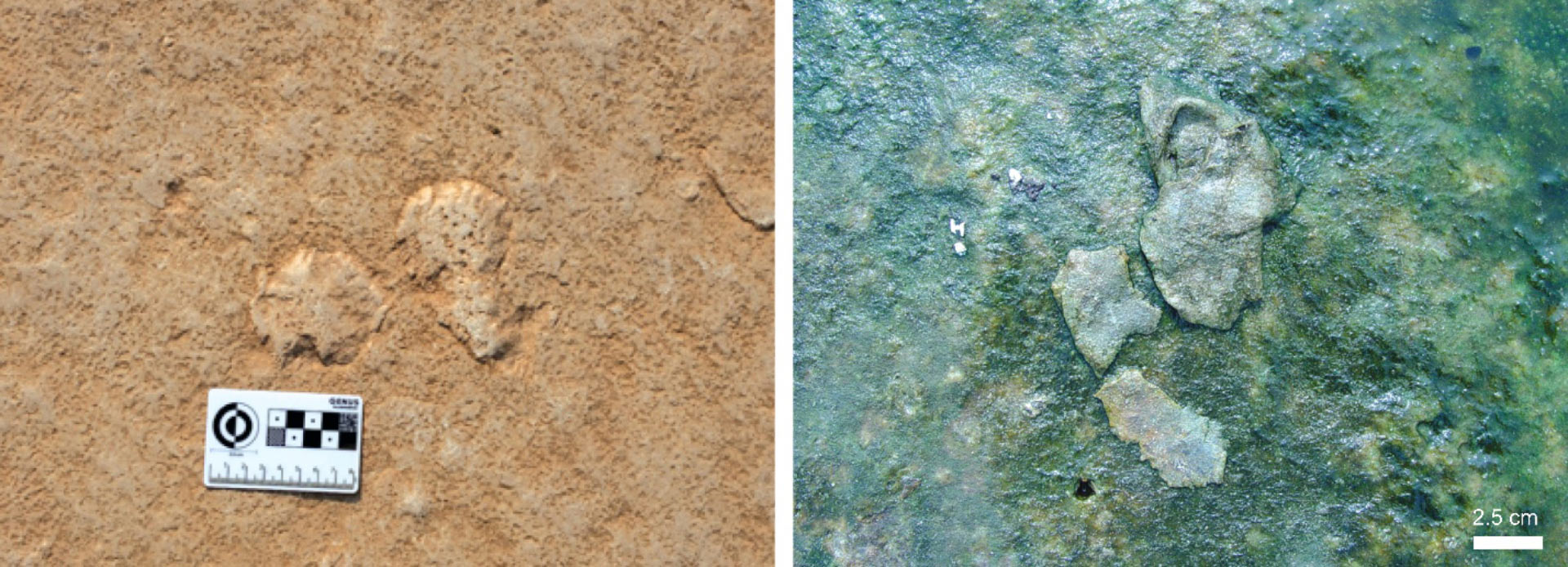
Microbial mat chips scattered on a Cambrian (left) and modern-day (right) tidal flat surface. Image credit: Nora Noffke.
“Today, vast microbial mat systems develop in tidal flats and lagoons along the coastlines of Earth’s oceans,” said Old Dominion University Professor Nora Noffke, lead author of a study published in the journal Palaios.
“These modern mats occur in the same states of growth, tatter, and desiccation as seen at Blackberry Hill.”
“Without them, our knowledge of life and earthly events through the ages would be largely obscured by ancient currents, waves, and the damage of time.”
_____
N. Noffke & K.C. Gass. 2026. Microbial mat facies in Cambrian tidal flats and implications for the trace fossil record (Elk Mound Group, Wisconsin, USA). Palaios, p. 74-90; doi: 10.2110/palo.2025.042
